Volatility-Based Position Sizing: Using ATR to Right-Size Trades on NQ, ES and MNQ
Why a Fixed Risk Percentage Isn't the Whole Story
Most beginner guides stop at "risk 1% of your account per trade." That's a solid starting point, but it leaves out a critical question: 1% based on what stop distance?
If you place the same dollar stop on a quiet day and a day when NQ is ripping 400 points in an hour, you're taking wildly different amounts of real risk while thinking you're being consistent. The missing ingredient is volatility.
What ATR Actually Measures
The Average True Range (ATR) is a simple indicator that measures how much an instrument typically moves over a given period, usually 14 bars. ATR measures the average magnitude of price movement per bar including gaps.
The core idea behind volatility-based sizing is simple: ATR-based position sizing is the most practical application of this indicator. The core principle: every trade should risk the same dollar amount, regardless of the stock's volatility. ATR makes this possible by converting volatility into a per-share stop distance.
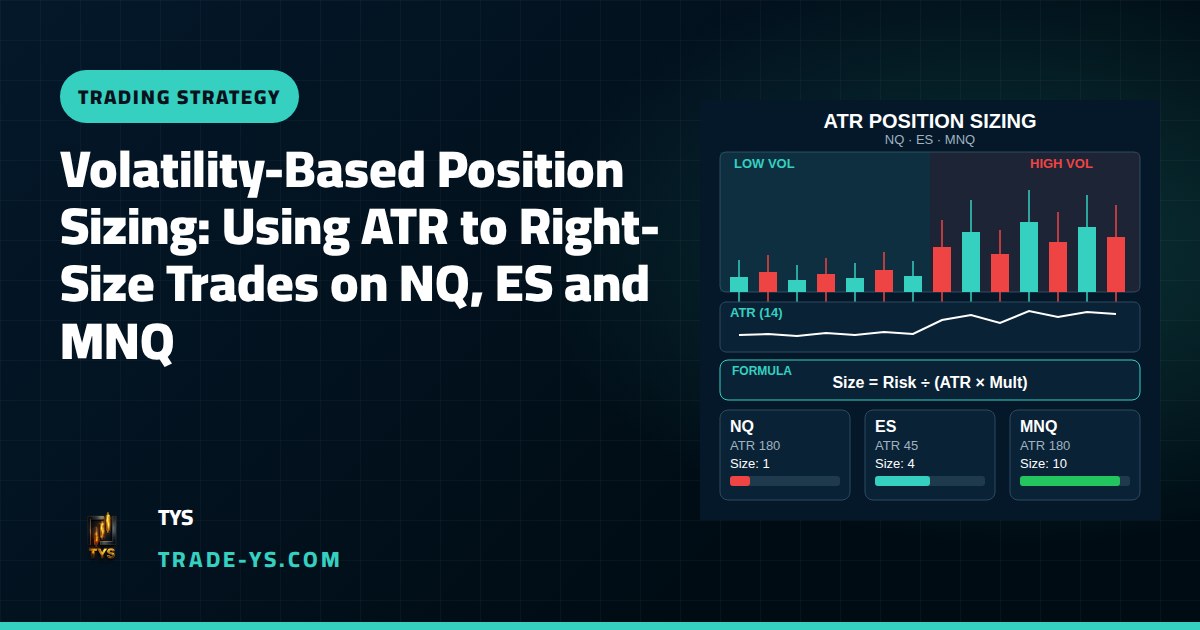
In practice, that means when volatility expands, your position size should shrink — and when the market calms down, you can size up slightly, all while keeping the same dollar risk on every single trade.
The Formula
The standard version most traders use looks like this:
Position Size = Account Risk ($) ÷ (ATR × Multiplier)
Breaking it down: Account Equity is your total account value, Risk % is the percentage of your account you are willing to lose on this trade (typically 1-2%), ATR is the 14-day Average True Range in dollar terms, and the Multiplier is how many ATRs away you place your stop loss (typically 1.5x to 3x).
So instead of deciding "I'll trade 2 contracts" first and then figuring out where to put your stop, you flip the process: you set your stop based on where the chart actually invalidates your idea, then let that distance tell you how many contracts you can afford.
A Concrete Example: Sizing an MNQ Trade
Let's apply this to a futures account trading the Micro E-mini Nasdaq-100 (MNQ), which is a common choice for retail-sized accounts because of its lower capital requirement. MNQ tracks the Nasdaq 100 at $2 per point, with a $100-300 typical day-trading margin, compared to the full-size NQ contract, where the standard E-mini (NQ) requires roughly $38,000 in overnight margin.
Say your account is $10,000 and you decide to risk 1% per trade, or $100. On the day you want to trade, the 14-period ATR on your chart is 60 points, and your strategy calls for a stop placed at 1.5x ATR, meaning a 90-point stop.
Using the formula: Position Size = $100 ÷ (90 points × $2 per point) = $100 ÷ $180 ≈ 0.55 contracts
Since you can't trade half a contract, you round down to 0 or decide the trade doesn't fit your risk budget that day — which is itself useful information. If ATR had been 30 points instead (a calmer market), the same $100 risk budget would have allowed roughly 1 full MNQ contract at a 45-point stop. The position size moves with the market's actual behavior, not with a number you picked out of habit.
Choosing Your Multiplier
The multiplier is where strategy and personal risk tolerance come in. Traders usually rely on a 14-period ATR as the standard and apply a multiplier between 1.5x and 3.0x — lower multipliers suit aggressive strategies, while higher ones provide more room for strategies requiring flexibility. A scalper working tight ICT-style entries around a liquidity sweep might use a tighter multiple; a swing trader holding through a full session might need more room to avoid getting stopped out by normal noise.
There's no universally "correct" multiplier — it should match how your specific strategy defines invalidation, tested over a meaningful sample of trades rather than guessed on the fly.
Combining ATR Sizing With Account-Level Rules
Volatility-based sizing handles the per-trade question. It doesn't replace account-level discipline:
- A maximum daily loss limit, common in prop firm rules, still applies regardless of how any single position was sized.
- Correlated positions matter too — a long NQ trade and a long ES trade on the same morning aren't really two independent risks; they tend to move together, so your total exposure can be larger than it looks on paper.
- Margin is not the same as risk. Just because a broker lets you hold a position doesn't mean the position fits your actual risk budget — the example above shows margin and dollar-risk are two separate checks.
A Few Practical Notes for Futures Traders
Margin requirements for E-mini and Micro E-mini contracts change over time and vary by broker, so always confirm current figures directly with CME Group or your broker before sizing a trade — the numbers above are illustrative, not fixed. Volatility itself also shifts across sessions: the ATR you calculate during the New York open can look very different from the ATR during the Asian session, so recalculate rather than reusing yesterday's number blindly.
Risk Reminder
This article is for educational purposes only and does not constitute financial advice. Futures and leveraged products carry a high level of risk and are not suitable for every investor. Past performance and backtested examples do not guarantee future results. Always size positions according to your own risk tolerance, account size, and a tested plan — and never risk money you cannot afford to lose.
If you want to see how TYS applies risk and position-sizing discipline alongside Smart Money Concepts on NQ and ES, keep an eye on our ongoing analysis and breakdowns.