Trailing Drawdown and Consistency Rules: The Prop Firm Fine Print That Decides If You Get Paid
Trailing Drawdown and Consistency Rules: The Prop Firm Fine Print That Decides If You Get Paid
Most traders prepare for a prop firm challenge by focusing on the profit target. That's the wrong starting point. The rules that actually end accounts — and block payouts even after you pass — are the drawdown type and the consistency rule. If you don't understand these before you buy an evaluation, you can trade well and still lose the account on a technicality.
This article breaks down the two pieces of fine print that matter most, with one concrete example, so you can build a risk plan that actually fits the rules you're trading under.
Static vs Trailing Drawdown: Not the Same Risk
Every prop firm sets a maximum loss limit, but the way that limit moves is completely different between firms, and sometimes between the evaluation and funded phases of the same firm.
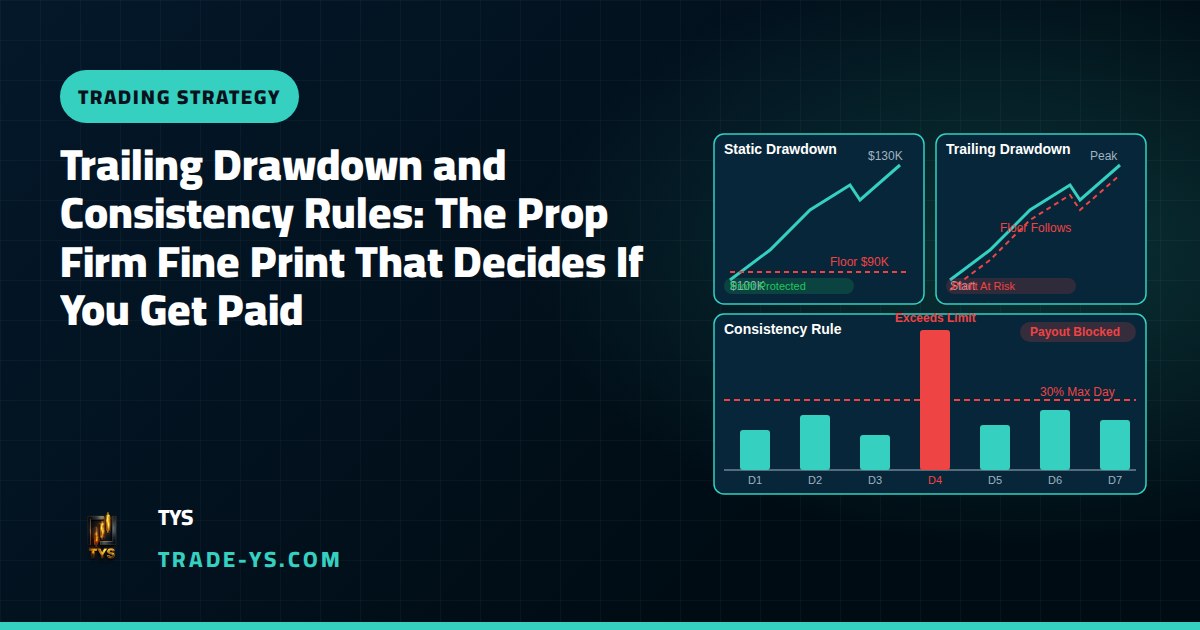
Static drawdown is measured from a fixed point, normally your starting balance. A 10 percent limit on a 100,000 dollar account is a floor at 90,000 dollars and it stays there. That means with a static model, a trader who grows their $100,000 account to $130,000 still has the original $90,000 floor. Profit becomes real protection.
Trailing drawdown is measured from your high-water mark. The floor follows your account upward and never comes back down. This sounds similar to static but changes everything about how "safe" your profit cushion really is. On the trailing account, profit buys nothing — you are always exactly one fixed-dollar drawdown from the end, on day one and on day one hundred.
There are also sub-types. With intraday trailing, the adjustment happens in real time, even with floating unrealized profits, making it easier to breach if your trades swing. End-of-day (EOD) trailing is more forgiving, as it only updates based on your closed profits at the end of each trading day. Some firms even mix models: some firms use static drawdown during evaluation and trailing during the funded phase.
Neither type is "better" in absolute terms. Static drawdown suits patient traders building a cushion slowly, while trailing suits aggressive traders who can lock in gains fast; trailing forces continuous discipline because complacency after a hot streak can still breach the floor.
The Consistency Rule: It Doesn't Stop a Trade, It Stops a Payout
The second piece of fine print catches even traders who pass the evaluation cleanly. A consistency rule caps the percentage one trading day can contribute, commonly 20-50% of total profit. Crucially, the rule applies at payout request time, not trade execution time — you can have a large winning day during the eval and the firm won't block the trade, it only matters when you ask for the money.
Rules vary widely by firm and even by plan. One firm's consistency rule says no single day can make more than 50% of total evaluation profit on some plans, or 30% on others. In general, your best winning day cannot exceed roughly 30% of your cumulative payout-period profits at the moment you request a withdrawal. If one trade carries the whole month — say a big NQ move on an FOMC day — the rule punishes traders who catch big moves on news, FOMC days, or trend days where one trade carries the week.
A Concrete Example
Imagine a $50,000 futures account with a $2,500 trailing drawdown and a 50% consistency rule. On $50,000 with a $2,500 drawdown, if you rise to $52,000 the limit goes from $47,500 to $49,500 — and stays there even if you pull back.
Now suppose this trader has a great week trading the New York session on NQ, catching one strong liquidity sweep and reversal that nets $1,800 in a single day, out of $3,000 total profit for the evaluation period. That single day represents 60% of total profit — above the 50% cap. Even though the account is profitable and the drawdown was never touched, the payout request would be rejected until the trader adds more profitable days to dilute that one outlier below the threshold.
This is exactly why "I passed the challenge" and "I can withdraw" are two different milestones.
Building a Risk Plan Around the Rules, Not Around the Target
A risk plan for a prop challenge should be built backward from the drawdown type and consistency rule, not forward from the profit target.
- If your drawdown is trailing, size your risk from the buffer that's left, not from the account balance. A 1% risk per trade on $50,000 means little once the floor has trailed up close to your equity.
- If your drawdown is intraday trailing, be extra careful with unrealized profit on open positions — a floating gain that evaporates can still have already pulled your floor up.
- If there's a consistency rule, avoid trying to hit the whole profit target in one trade. Spread gains across several sessions deliberately, even if that means taking a smaller position on an obviously strong setup.
- Always know your daily loss limit separately from your max drawdown — these are two different numbers on most firms, and breaching either one ends the account.
None of this replaces a sound entry methodology. Risk management around these specific rules simply protects the account you already have while your edge plays out over enough trades to matter.
A Short Checklist Before You Buy an Evaluation
- Is the drawdown static, EOD trailing, or intraday trailing — and does it change once funded?
- What percentage is the consistency rule, and does it apply at the evaluation stage, the funded stage, or both?
- What is the daily loss limit, separate from the overall drawdown?
- How is the buffer calculated for your first payout request?
Taking ten minutes to answer these four questions before purchasing a challenge will do more for your odds of actually getting paid than any entry strategy.
Risk Reminder
Prop firm rules change frequently and vary firm by firm — always verify current terms directly with the firm before trading. This article is educational only and is not financial advice or a promise of profit. Trading futures and prop firm evaluations both carry real risk of loss; never risk capital you cannot afford to lose.
Want more breakdowns like this applied directly to NQ and ES price action? Follow TYS for our ongoing Smart Money and ICT-based market analysis.
