Timing Is Everything: Applying Smart Money Sessions and Killzones to NQ and ES Futures
Why Timing Changes Everything
Two traders can look at the exact same NQ chart, draw the exact same order block, and get completely different results — because one took the trade at 3 AM New York time and the other took it during the New York open.
Smart Money Concepts (SMC) isn't just about where price might react. It's also about when institutional participants are actually active enough to make that reaction meaningful. This is where session timing and "killzones" come in, and it's one of the most overlooked pieces of the puzzle for NQ and ES futures traders.
The Three Sessions That Shape the Day
Futures markets trade nearly 24 hours, but liquidity and volume are not evenly distributed. Three windows matter most:
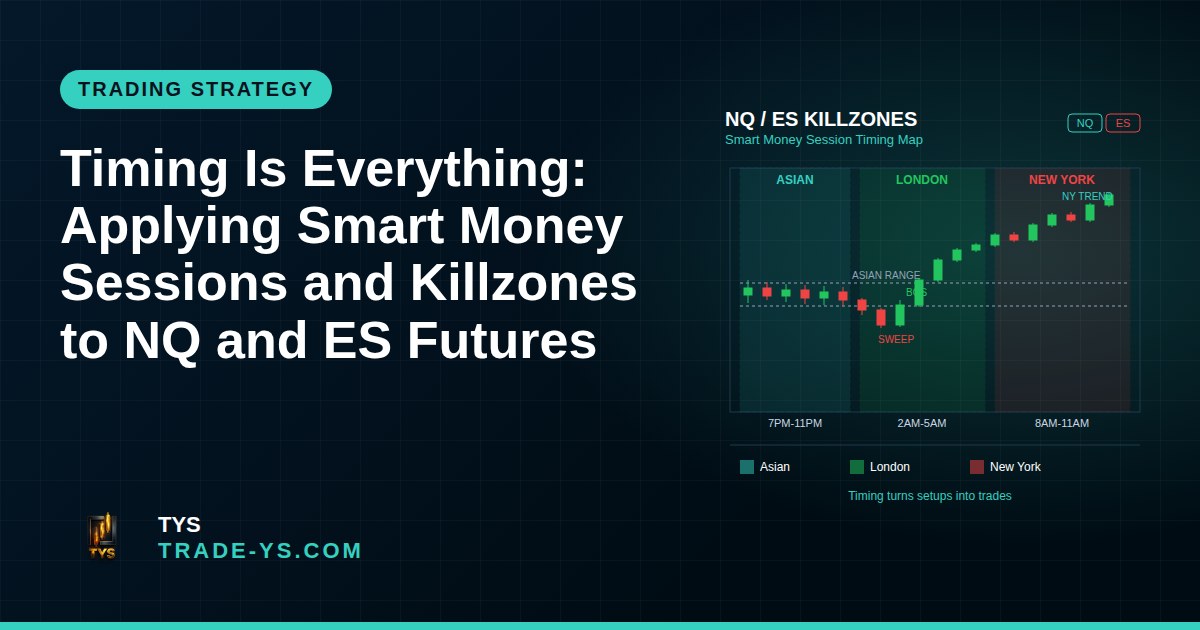
Asian session — Timed roughly between 7:00 PM and 11:00 PM New York time, this window identifies windows of opportunity within the session. Volume is thin, so price tends to build a tight range rather than trend. That range becomes a reference point for later sessions.
London session — For many traders, the trading day truly begins when London opens, generally running from 2:00 AM to 5:00 AM New York time. This window frequently establishes the day's initial direction, often attacking the highs or lows created during the Asian session before beginning a sustained move.
New York session — This window begins as the US session opens while London is still active, creating one of the busiest periods of the trading day by combining liquidity from the world's two largest financial centres, typically running from 7:00 AM to 10:00 AM New York time. For NQ and ES specifically, the New York AM window — roughly 9:30 to 11:00 AM ET around the cash open — is where the majority of the day's volume and range gets established.
The "Judas Swing": A Pattern Worth Knowing
One recurring pattern SMC traders watch for is the so-called Judas swing. The idea: price pushes through a recent high or low early in a session — grabbing the stop-losses and breakout orders resting there — only to reverse and travel in the opposite direction once that liquidity has been absorbed.
During the London window, institutions frequently engineer a liquidity sweep of the Asian session range before launching the true directional move of the day. The same logic can repeat at the New York open relative to the London range: the New York window usually reacts to liquidity created during the European session, and depending on market conditions, it may continue London's trend or completely reverse it, especially after major U.S. economic data.
For NQ and ES, this means the first 30-60 minutes of a session are often more about collecting liquidity than about the "real" move — which is exactly why patient traders wait for a market structure shift (a break of the opposite swing point) before committing to a direction.
A Simple Walkthrough
Imagine the Nasdaq (NQ) built a narrow overnight range during the Asian hours, say a 150-point box. When London opens, price spikes above the overnight high, taking out resting buy-stops — then sharply reverses and breaks back below the overnight low. That reversal is a textbook liquidity sweep. A trader watching market structure might then look for price to form a fair value gap or order block on the way down and treat a pullback into that zone as a potential area of interest for continuation lower, always with a defined invalidation point.
This isn't a guaranteed setup — reversals don't happen every single day, and sometimes the "sweep" simply becomes the new trend. That's why context (higher timeframe bias, news events, overall trend) still matters more than any single pattern.
Context From Today's Market
Recently, Nasdaq pushed to another record high, driven by continued strength in AI and semiconductor stocks, while US Treasury yields pulled back, taking some pressure off high-growth tech stocks. At the same time, market concentration has grown, with Nvidia, Apple, and Microsoft representing over 21% of the S&P 500. That kind of concentration means a handful of mega-cap earnings or news items can move NQ and ES more sharply than usual — another reason why when you trade matters as much as what pattern you're trading.
Practical Takeaways
- Don't treat every session the same. The first moves of London or New York often exist to sweep liquidity, not to start the "real" trend.
- Wait for confirmation — a structure shift or displacement — rather than assuming the first breakout is the final direction.
- Keep a higher timeframe bias in mind; a Judas swing against the broader trend is a very different trade than one in line with it.
- Watch the economic calendar. Major U.S. data releases often land inside the New York window and can override any session pattern.
A Final Word on Risk
None of this is a signal to buy or sell, and no session pattern works every time. Futures trading carries significant risk, and past price behavior — including recurring patterns like liquidity sweeps — never guarantees future results. Always define your risk before entering a trade, and size positions according to a plan you can live with even if the trade goes against you.
If you want to see how these session concepts play out in real time on NQ and ES, keep following TYS's daily analysis — we break down the sessions, the sweeps, and the structure shifts as they happen.
