This Week's Macro Shock: How a Weak Jobs Report Moved Indices and Gold — And What's Still Ahead
Why One Data Release Can Move Everything
If you trade NQ, ES, or gold, you've probably noticed that the calmest charts suddenly turn violent at 8:30 or 2:00 pm New York time on specific days. That's not random. It's the economic calendar doing its job.
This week gave us a textbook example. The US released its September jobs report, and the reaction across indices, the dollar, and gold showed exactly why serious traders build their week around these releases instead of ignoring them.
What Just Happened: The September Jobs Report
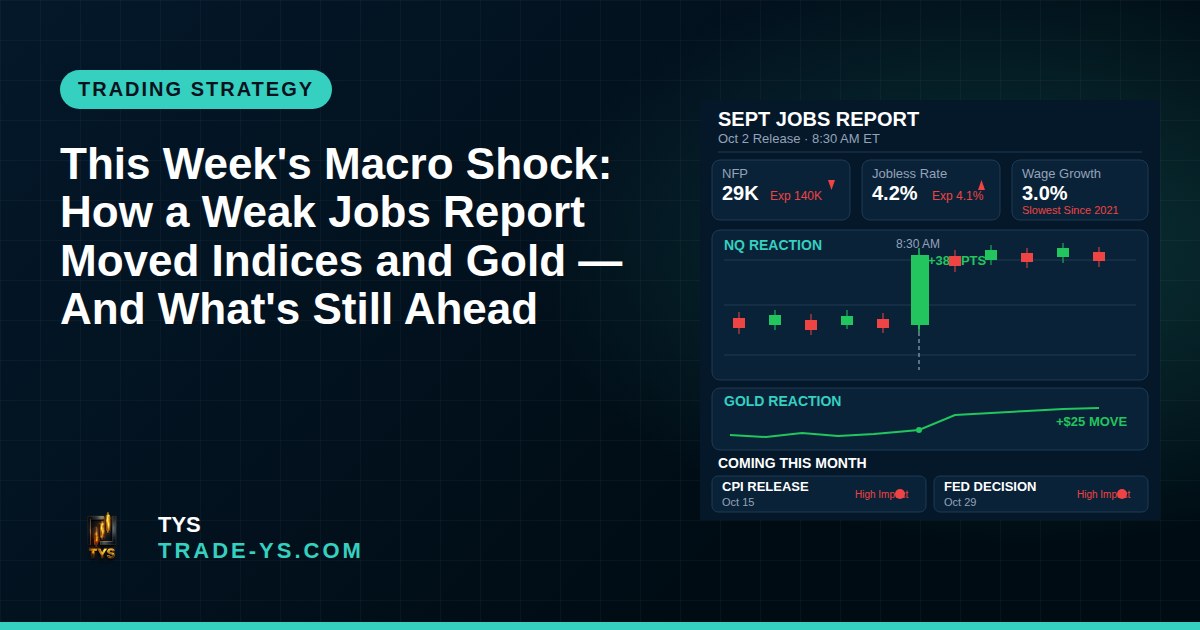
On Friday, October 2, the Bureau of Labor Statistics published the September Employment Situation report. The numbers came in much softer than expected. The US added fewer jobs than expected in September and wage growth slowed; nonfarm payrolls increased only 29,000 and revisions cut 60,000 jobs from the prior two months. The unemployment rate unexpectedly rose to 4.2%, though that partly reflected an increase in the participation rate to a four-month high of 61.8%, which is a positive sign. Average hourly earnings edged up a weaker-than-expected 0.1% from August and rose 3% compared with a year earlier — the slowest annual wage growth since 2021.
The market consensus going in had expected a much stronger number, so the miss was significant.
How the Market Reacted
This is the part that matters most for traders. S&P 500 futures rose following the release and Treasury yields and the dollar declined, while traders trimmed bets for a Fed rate hike this year.
Gold's reaction followed the same logic. Weak jobs data reduces the odds that the Fed needs to keep policy tight, which tends to pull down yields and the dollar — both supportive for gold. Around that period, gold was trading near the $4,140 area, still 4.45% higher than a year ago, according to trading on a contract for difference (CFD) that tracks the benchmark market for this commodity, even after a pullback from its earlier highs.
This is the core mechanism to understand: bad news for the labor market is often "good news" for risk assets and gold in the short term, because it lowers the probability of further rate hikes. It's counterintuitive until you see the chain reaction a few times.
Context: Why the Fed Is So Sensitive Right Now
This jobs report didn't land in a vacuum. The US Federal Reserve made its latest interest rate decision on Wednesday, September 16, opting to increase the target range to 3.75 to 4 percent in its first hike in more than three years. That hike was driven by inflation concerns, which is why every subsequent labor and price report is being scrutinized for clues about the Fed's next move.
What's Still Ahead This Month
The week's news doesn't stop at the jobs report. Two more high-impact events are on the calendar before the month is out:
CPI — September inflation data. The US Bureau of Labor Statistics will release Consumer Price Index data for September 2026 on Wednesday, October 14, 2026, coming roughly two weeks before the Federal Open Market Committee meets on October 28, 2026, for its next rate decision. This report will tell markets whether inflation is still running hot after the September hike, or cooling off.
The Fed decision. The October 2026 FOMC meeting is October 27-28, 2026, with the Fed interest rate decision announced Wednesday, October 28, 2026 at 2:00 PM ET. As of early October, futures markets were leaning toward the Fed holding rates steady rather than hiking again, though that can change quickly depending on what the CPI report shows.
A Concrete Example of Why This Matters
Imagine a trader holding a long gold position going into the September 16 Fed decision without knowing a hike was likely. The gold price was largely stable before the Fed's decision, trading around US$4,353 per ounce, but quickly plunged 2.43 percent after the news to reach US$4,247.86 by 3:15 p.m. EDT. That's over $100 per ounce of movement in minutes — enough to wipe out days of patient technical analysis if position sizing wasn't adjusted for the event.
The lesson isn't "never trade on news days." It's "know what's on the calendar, and size your risk accordingly."
How to Prepare for the Rest of October
- Mark the dates. October 14 (CPI) and October 28 (FOMC decision) are now on your calendar, not a surprise.
- Expect wider ranges and false moves in the hour around each release — liquidity often gets swept in both directions before the real move develops.
- Reduce size or stand aside going into the release itself if you don't have a clear, pre-planned reason to be in the market.
- Let the dust settle. The first one-to-two candles after a major release are often noise; structure usually becomes clearer a little later.
- Think in scenarios, not predictions. Instead of guessing the CPI number, plan how price on NQ, ES, and gold might react if inflation comes in hot versus cool.
Final Thoughts
Weeks like this one are a reminder that technical setups don't exist in a vacuum — they sit on top of a macro backdrop that can override them in seconds. Understanding the "why" behind a jobs report, a CPI print, or a Fed decision helps you react with a plan instead of emotion.
At TYS, we keep an eye on exactly these events and how they ripple through NQ, ES, and gold, so our community can approach high-impact days with context rather than guesswork. Feel free to follow our analysis as the CPI and FOMC decisions approach.
Risk Reminder: This article is for educational purposes only and does not constitute financial advice or a recommendation to buy or sell any instrument. Trading futures, forex, and other leveraged products carries a high level of risk and can result in the loss of your capital. Always do your own research and manage risk according to your own situation.
