The Tilt Cycle: Why Disciplined Traders Build Circuit Breakers, Not Willpower
It Never Starts as a Decision
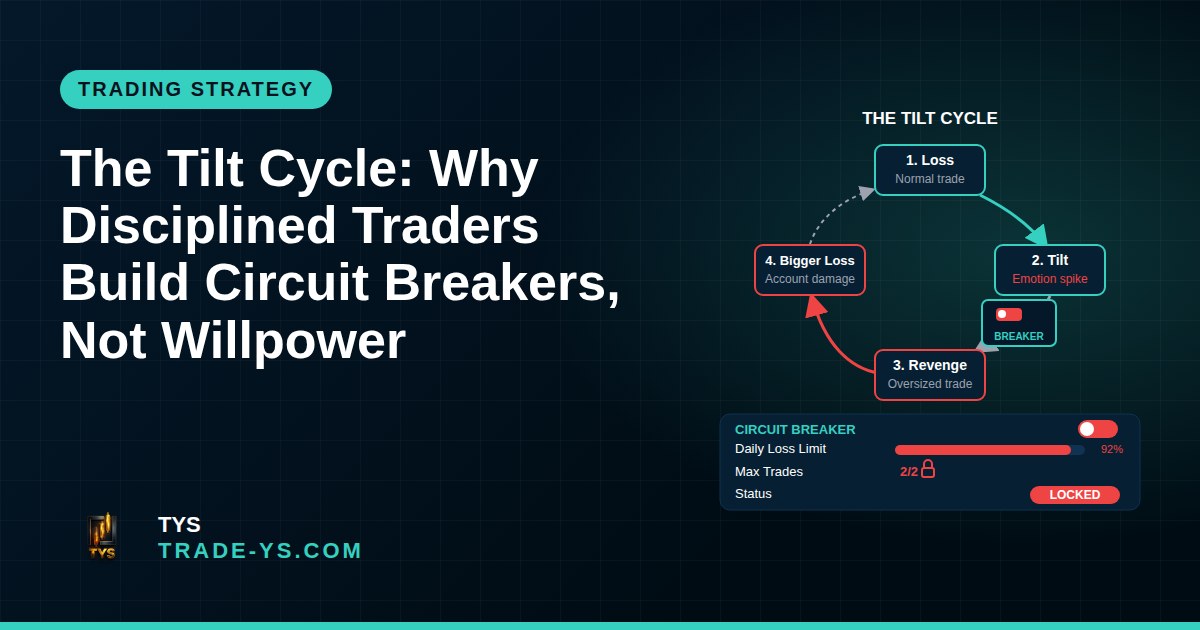
Nobody wakes up planning to blow up their account. It usually starts with one trade that goes wrong — a stop that gets hit right before price reverses, a setup that looked perfect and wasn't. Then, within minutes, a second trade appears. Bigger size. No real setup. Just a need to "fix it."
That's not a strategy failure. It's a psychological one. And it has a name poker players coined long before trading forums did: tilt.
What "Tilt" and Revenge Trading Actually Are
Tilt is the broader state where emotion overrides your process. Revenge trading is the specific behavior that tilt produces in markets: taking trades, usually quickly, with larger size, against your normal rules, specifically to recover a recent loss, driven by emotion rather than strategy. You can overtrade without being angry — chasing a winning streak counts too — but most revenge trading happens on tilt.
The pattern is remarkably consistent across traders: you take a normal loss, you feel angry or embarrassed, and you enter another trade quickly, often without proper setup criteria.
Behavioral finance gives this a name too. Research from the CFA Institute and prospect theory work by Daniel Kahneman and Amos Tversky suggests traders are heavily influenced by loss aversion — losses feel psychologically stronger than gains, which can push decision-making off the rails under pressure.
What Overtrading Actually Costs
This isn't just a theory. It's one of the most tested ideas in finance. The landmark Barber and Odean study of tens of thousands of brokerage accounts found that the most active traders earned just 11.4% per year while the market returned 17.9% over the same period — a 6.5 percentage point annual drag. The gap wasn't about bad picks. Gross returns were nearly identical across groups; all the destruction happened after transaction costs and the accumulated impact of poorly timed decisions.
Researchers kept finding the same root cause everywhere they looked. Overconfidence was identified as the cause: traders consistently overestimated their informational edge, leading them to trade when sitting still would have served them better. In futures and intraday markets, where leverage amplifies every decision, that same overconfidence turns a single bad entry into a cascading problem far faster than it would in a buy-and-hold stock account.
A Simple Example
Imagine a trader risking 1% per trade on NQ futures with a plan to take a maximum of three A+ setups per session. The first trade hits a stop during the New York open — a normal, planned loss. Instead of stepping back, the trader re-enters within two minutes, doubles size "to make it back faster," and skips the usual confluence checklist (liquidity sweep, market structure shift, fair value gap). That second trade isn't really a trade anymore — it's an emotional reaction wearing a trade's clothes. If it loses too, the drawdown for the day can now be three or four times the original planned loss, from one unplanned decision.
Circuit Breakers Beat Willpower
Telling yourself "I'll just be more disciplined next time" rarely works in the moment, because by the time tilt sets in, the part of your brain weighing probabilities has already been overridden. What works better is building mechanical circuit breakers before you need them:
- A hard daily loss limit. Decide in advance how much you can lose before you are done for the day — and treat hitting it as a rule, not a suggestion.
- A maximum trade count. Cap the number of setups you'll take per session, so "one more trade" isn't an open-ended option.
- A mandatory cooldown after a loss. Even five or ten minutes away from the screen breaks the automatic reflex to re-enter immediately.
- A pre-trade checklist. If a trade doesn't tick every box of your plan (session, structure, confirmation), it doesn't get taken — no exceptions for "this one feels different."
- A journal entry before re-entering. Writing down why you're taking the next trade, in plain language, forces the analytical brain back online before the emotional one pulls the trigger.
None of these rules eliminate losses — no system does. What they do is cap the damage from the moments when emotion, not analysis, is driving the decision.
The Real Skill Is Noticing It Early
Professional traders aren't immune to the urge to revenge trade. The difference between professionals and retail traders isn't that pros never revenge trade — it's that pros have systems to prevent it when they notice it happening. Noticing is the skill. A quick self-check — "am I taking this trade because my plan says to, or because I need to feel better?" — is often enough to break the cycle before size gets added and rules get bent.
Discipline, in the end, isn't about never feeling the urge. It's about having rules strong enough to survive the moments when you do.
Final Thought
Trading psychology isn't separate from strategy — it's part of it. The best entry model in the world can't protect an account from a trader who abandons it under pressure. Building small, boring safeguards into your routine is often what separates a manageable losing day from a damaging one.
We'll keep sharing practical breakdowns of ICT and Smart Money concepts, risk frameworks, and market context on TYS — feel free to follow along as we go deeper into how structure, psychology, and risk fit together in futures trading.
Risk reminder: This article is for educational purposes only and does not constitute financial advice. Trading futures and other leveraged instruments carries a high level of risk and may not be suitable for everyone. Past performance and research findings do not guarantee future results. Always assess your own financial situation and risk tolerance before trading.
