The Pre-Market Routine: A Trader's Daily Checklist Before the Opening Bell
Why a Pre-Market Routine Matters
Most losing trades don't start with a bad entry. They start with a trader sitting down with no plan, no levels marked, and no idea what news is due that day. A short pre-market routine — done the same way every day — removes a lot of that randomness before the first candle even forms.
This isn't about predicting the day. It's about showing up prepared, so that when an opportunity appears, you already know whether it fits your plan or not.
Step 1: Check What Happened Overnight
Futures like NQ and ES trade almost around the clock. Most CME futures—including the S&P 500 (ES) and Nasdaq-100 (NQ)—open Sunday at 6:00 PM Eastern Time and trade nearly around the clock until Friday at 5:00 PM ET. Every day there is a one-hour maintenance break from 5:00 PM to 6:00 PM ET.
Traders generally split this into sessions. Traders commonly call 6:00 PM to 2:00 AM ET the Asian session and 2:00 AM to 9:30 AM ET the European or London session, while the U.S. cash session runs from 9:30 AM to 4:00 PM ET.
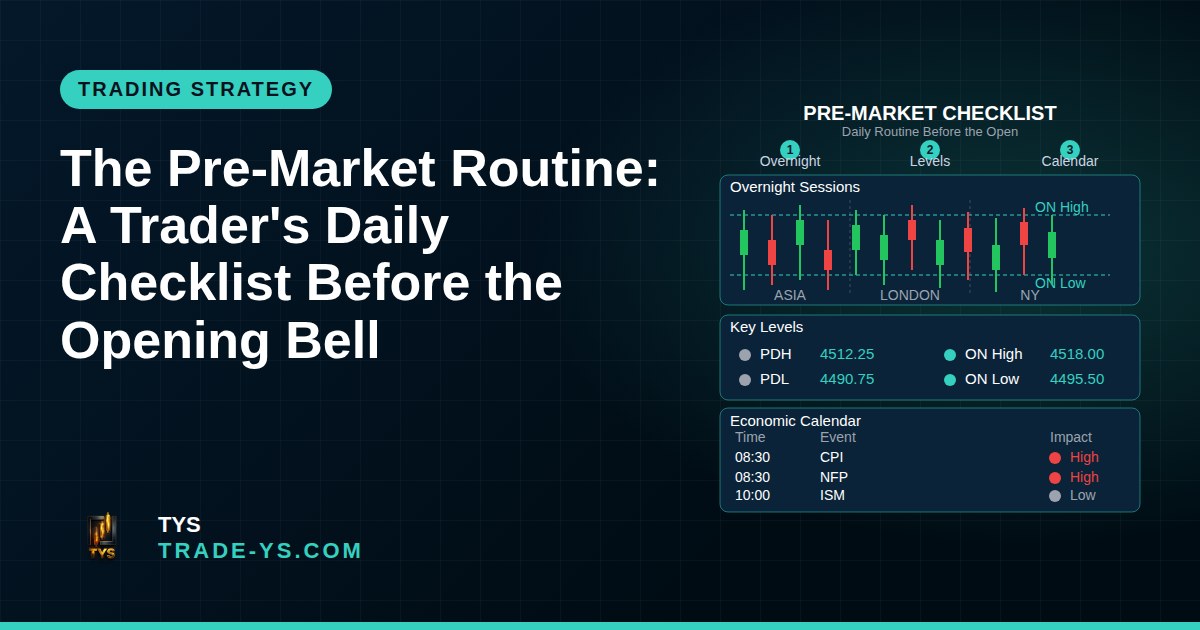
Before you do anything else, scroll back through the Asia and London sessions. Note the overnight high and low, whether price is trending or stuck in a range, and whether there was a sharp move tied to a headline. This gives you context before the New York session opens.
Step 2: Mark Your Key Levels
With the overnight range in front of you, mark the levels that actually matter:
- Previous day's high and low
- Overnight high and low
- Any untested order block, fair value gap, or liquidity pool from your higher-timeframe analysis
- A major round number or prior week's high/low if price is close to it
The goal isn't to mark everything — it's to mark the three or four levels where you'd actually consider reacting. A chart with twenty lines on it is as useless as a chart with none.
Step 3: Scan the Economic Calendar
This step is easy to skip and expensive to skip. An economic calendar lists every scheduled economic release, from Nonfarm Payrolls to central bank rate decisions, ranked by how much volatility each one typically produces.
A simple habit works well here: review the week's economic calendar before the trading week begins and each day's events before the market opens. A small handful of recurring releases account for a disproportionate share of the volatility flagged on the calendar: Nonfarm Payrolls, CPI, GDP, unemployment data, and central bank interest rate decisions from the Federal Reserve, European Central Bank, and Bank of England.
Two practical rules:
- Know the exact time. Setting mobile alerts 15 to 30 minutes before high-impact releases reduces missed trades, so open the calendar at the start of your session and know the exact release time before you place a single trade.
- Respect the few minutes around it. Many traders simply choose not to open new positions in the minutes immediately before a major release, because spreads widen and price can spike in both directions without warning.
Remember what the calendar can and can't do for you: technical analysis explains where price may move, while economic events often explain why it moves — preparation doesn't guarantee profits, but it gives you a significant advantage over trading blindly.
Step 4: Define Your Bias — and Your Invalidation
Once you've seen the overnight range, your key levels, and the day's news, write one sentence: "I'm expecting X unless price does Y." For example: "I expect NQ to sweep the Asia low and reverse toward the overnight high, unless it closes below that low on the 15-minute chart — in which case I stand aside."
This single sentence forces you to define invalidation before you're in a trade, when you can still think clearly.
Step 5: Set Alerts and Step Away
Don't stare at the chart waiting for your level. Set a price alert on your key levels and on the calendar event, then step away. Reviewing your plan every five minutes doesn't improve it — it just invites impulsive changes.
A Simple Example
Imagine it's a Tuesday. Overnight, NQ swept Monday's low during the London session and is now sitting just under the Asia session high. Today's calendar shows US CPI at 8:30 AM ET. A simple routine would look like this: mark Monday's high/low and the Asia high, note the CPI time, decide not to take new entries in the 15 minutes before the release, and define one clear scenario for what happens if price reclaims the swept low versus if it fails to. That's the whole prep — no prediction, just a plan.
Final Reminder
A good morning routine doesn't guarantee a good trade. Markets can still move in ways no calendar or chart warned you about, and even a well-prepared setup can lose. This article is for educational purposes only and is not financial advice — always size your risk so that no single trade or news surprise can hurt your account, and never risk money you can't afford to lose.
If you want to see how this kind of daily prep looks in practice on NQ and ES, follow TYS's ongoing session breakdowns and market analysis.
