The October Fed Decision: Hot CPI, Weak Jobs, and What It Means for Nasdaq, S&P 500 and Gold
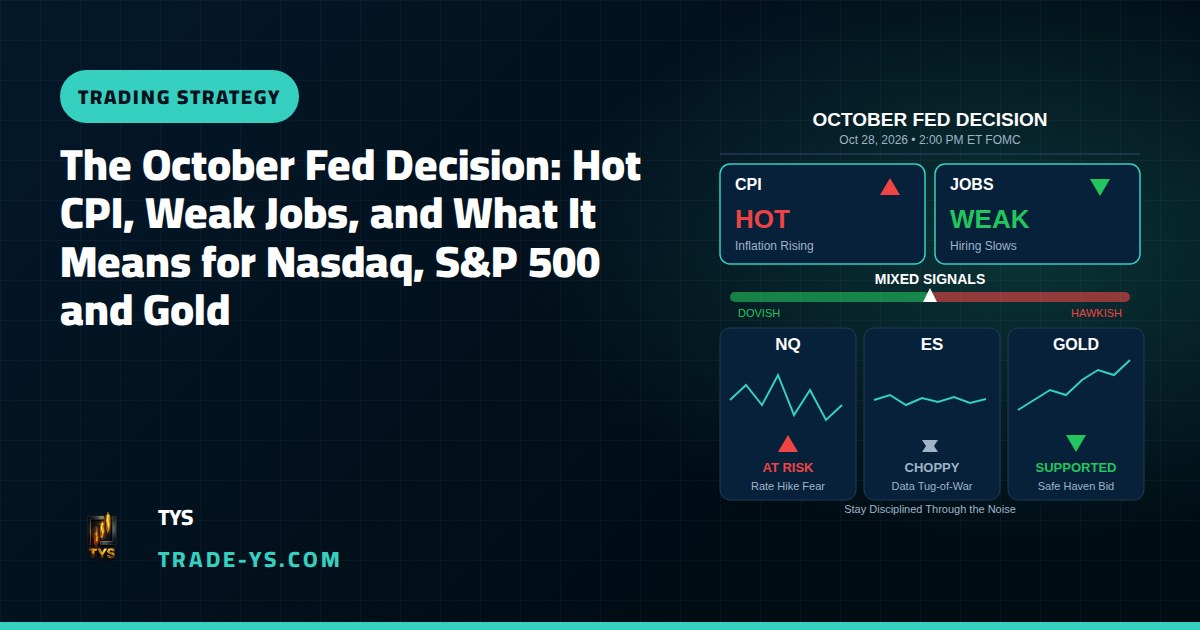
Every trader who watches indices or gold knows the feeling: a calendar date circled in red, and a market that seems to hold its breath beforehand. This week brings exactly that kind of event — the Federal Reserve's October interest rate decision — arriving after a stretch of economic data that has pulled in two different directions. Let's break down what's happening and why it matters for Nasdaq (NQ), S&P 500 (ES) and gold.
This Week's Big Event: The October FOMC Decision
The Federal Open Market Committee meets on October 27–28, 2026. The policy statement is released at 2:00 p.m. Eastern Time on Wednesday, October 28, followed by the Chair's press conference at 2:30 p.m. ET. This is one of the four 2026 meetings that does not include a Summary of Economic Projections, so there is no dot plot. That last detail matters: without fresh quarterly projections, traders will have to lean almost entirely on the statement's wording and the Chair's answers during the press conference to gauge the path ahead.
How We Got Here: A Few Confusing Months
To understand why this meeting is being watched so closely, it helps to rewind. The September 15–16, 2026 meeting concluded with a 25-basis-point hike to 3.75%–4.00% — the Fed's first increase since 2023. That decision came after a run of data that kept flipping the narrative.
In August, the Bureau of Labor Statistics reported nonfarm payrolls rose 162,000 in August — roughly triple the 53,000 economists expected — while the unemployment rate held at 4.1%. That strong print pushed hike odds higher heading into September.
Then came a reversal. When September's jobs report was released, employers added just 29,000 nonfarm payrolls in September, well below the 84,000 gain economists had expected. The unemployment rate ticked up to 4.2% from 4.1%, and the August payroll figure was revised down to 133,000. The market reaction was immediate: traders priced in just an 18% chance of a Fed hike in October, and gold rallied on the news.
Just as that dovish narrative settled in, inflation data pushed back the other way. September 2026 CPI, released 14 October 2026, showed headline CPI rose 0.6% on the month and 3.7% over 12 months, with core up 0.3% and 2.6%. Gasoline accounted for over half of the monthly increase. That headline came in hotter than expected, since the forecast had been 3.6%.
So heading into this week, the Fed faces a genuinely split picture: a labor market that's cooling, and inflation that refuses to fully cooperate. Unsurprisingly, prediction markets overwhelmingly expect a hold at the October meeting, with only about one-in-eight odds on another quarter-point increase.
Why This Tension Matters for Indices and Gold
Rate decisions move markets through a fairly simple chain: expectations about future interest rates affect bond yields and the dollar, and those two in turn affect both equity index futures and gold. When the market reprices how likely a hike, hold, or cut is, you'll often see Treasury yields and equity index futures react instantly to new information, with the move typically continuing for 10–15 minutes as the full composition of the data becomes clear. A headline beat with hot core data is generally bearish for risk assets; a headline miss with cool core data is generally bullish.
Gold works differently because it carries no yield. Higher real rates and a firmer dollar tend to weigh on bullion, while weaker data, lower yields, or a softer dollar tend to support it — which is exactly the mechanic behind gold's rally after the soft September jobs report.
A Concrete Example: One Friday, Two Opposite Reactions
Look at how the market behaved around the September jobs report alone. Before the release, gold had been struggling near resistance. Once the weak 29,000 print landed and unemployment ticked higher, hike odds collapsed and spot gold moved up 0.6% to $4,165.49 per ounce, while December gold futures rose 0.8% to $4,194.60. A single data point, released in an instant, repriced an entire asset class within minutes. That's the kind of volatility a Fed week, a CPI morning, or an NFP Friday can produce — and it's exactly why these events deserve respect rather than guesswork.
What to Watch This Week
Beyond Wednesday's 2:00 p.m. statement and 2:30 p.m. press conference, there's another data point worth marking: the PCE report on 29 October lands the day after the Fed decision. PCE is the Fed's preferred inflation gauge, so a surprise there — hot or cool — could extend or reverse whatever reaction the FOMC meeting produces. Two major catalysts back-to-back, in other words, not just one.
A Simple, Sane Approach to Trading Event Days
None of this is a signal to predict direction. If anything, weeks like this are a reminder that macro events create some of the sharpest, least predictable moves of the month. A few habits worth keeping in mind:
- Expect wider spreads and faster candles around 2:00–2:30 p.m. ET on Wednesday, and around CPI/NFP release times generally.
- Let the first violent move happen and settle before assuming you know the "real" direction — initial reactions often reverse once the details (core data, press conference tone) are digested.
- Reduce size or step aside entirely if you don't have a tested plan for high-volatility sessions. Protecting your account on a chaotic day is itself a form of edge.
Final Word
This week's Fed decision sits at the intersection of two stories that don't fully agree — a softening labor market and inflation that's still running above target. That disagreement is exactly why indices and gold have been so reactive to each new data point lately, and why Wednesday's statement and press conference deserve full attention even without a fresh dot plot.
If you want to follow how TYS is reading this week's Fed decision and its knock-on effects on NQ, ES and gold, keep an eye on our ongoing analysis.
Risk reminder: This article is for educational purposes only and is not financial advice or a signal to buy or sell any instrument. Trading futures, indices, and gold around high-impact news involves significant risk of loss, including the possibility of losing more than your initial investment. Past price reactions do not guarantee future results. Always use proper risk management and never risk money you cannot afford to lose.