Red Folder Days: A Tiered Framework for Trading Economic News Without Getting Run Over
Why the Calendar Is a Risk Tool, Not Just a Schedule
Most traders open an economic calendar to find the time of the next release. That's the easy part. The harder, more valuable skill is deciding how much respect each event deserves before it prints — because that decision determines your position size, your stop distance, and whether you're even in a trade when the number hits.
NQ and ES can move dozens of points in the seconds around a Consumer Price Index (CPI) report or a Federal Reserve decision. Spreads widen, liquidity thins out, and the first move is frequently a trap before the real direction shows up. Treating every calendar entry the same way — ignoring all of them or fearing all of them — is how traders either get blindsided or sit frozen on the sidelines for no reason.
Tier Your Events Instead of Treating Them Equally
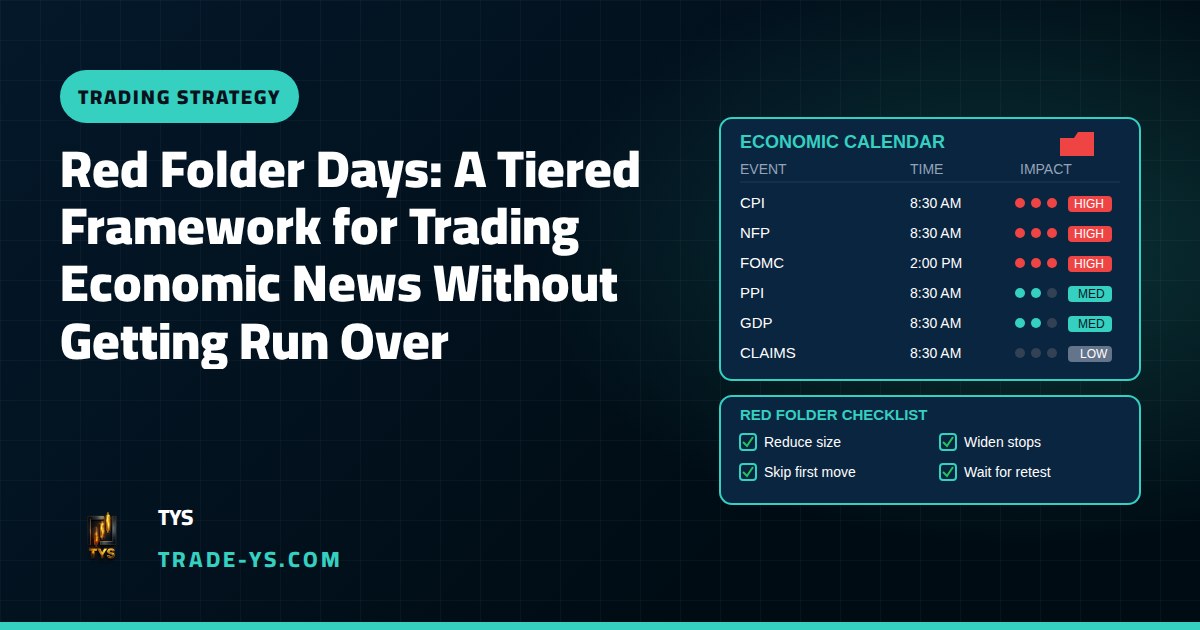
A simple three-tier system covers most of what matters for index and futures traders:
Tier 1 — High impact. Fed interest rate decisions (FOMC), CPI, the monthly jobs report (Nonfarm Payrolls), and PCE inflation. These routinely move the dollar, yields, gold and equity indices within seconds of release.
Tier 2 — Medium impact. PPI, retail sales, GDP, ISM/PMI surveys, and Fed speeches from voting members. These can move markets, especially if they surprise versus expectations, but the reaction is usually less violent than Tier 1.
Tier 3 — Low impact. Weekly jobless claims, regional Fed surveys, minor housing data. Worth knowing about, rarely worth building a trading plan around.
For context on what a genuine Tier 1 week looks like: in October 2026 the calendar lined up CPI on October 14, PPI and retail sales on October 15, the FOMC rate decision on October 28, followed the next day by Q3 GDP and the PCE inflation report, with the next jobs report scheduled for November 6. October 2026 has 8 major entries on this calendar, including Nonfarm Payrolls, FOMC Minutes, CPI Inflation, Retail Sales, PPI Inflation, FOMC Decision, GDP, PCE Inflation. That's a stretch where discipline around news matters more than usual.
When the Calendar Itself Becomes the Risk
Here's something many beginner guides skip: the calendar isn't always reliable, and 2026 has been a good reminder of that. A historic 43-day federal government shutdown disrupted the US statistical agencies' release schedule in late 2025, and the aftershocks kept hitting data through the year. Following last year's record shutdown that stretched into early November, the bureau also was forced to delay a number of its routine releases and was just catching up from that incident.
It happened again in early 2026: the Bureau of Labor Statistics will not be releasing the January jobs report as scheduled Friday due to the partial government shutdown, a department spokesman confirmed Monday. Economists at the time noted the knock-on effects were serious: the October CPI report (if released) will pose a serious data quality issue. The reality is we will get either an October report that is imputed OR the report may be canceled altogether.
The lesson isn't about politics — it's about process. When official agencies warn of delays, imputed data, or a rescheduled calendar, the sensible reaction is to double-check the release date on the agency's own site (BLS, BEA, Federal Reserve) the morning of your trading session, not to trust a calendar app from three weeks ago. A canceled or delayed CPI print can leave the market repricing an entirely different event than the one it expected.
The Volatility Window: Before, During, After
A practical way to manage any Tier 1 event:
- Before (15–30 minutes out): Reduce size or flatten existing positions if your stop sits inside the likely volatility range. Liquidity often gets swept just ahead of the release as larger orders get filled.
- During (the first 1–5 minutes): Expect spread widening and whipsaw. Many professional traders simply don't take new entries in this window — the first spike is frequently faded.
- After (15–60 minutes): Volatility is still elevated but often more directional. This is typically where a clearer structure forms and higher-quality setups appear.
A Simple Pre-News Checklist
- Check official release times (BLS, Fed, Census Bureau) rather than relying only on third-party apps.
- Identify which tier the event belongs to.
- Decide in advance: trade through it, reduce size, or stand aside entirely.
- If holding a position, know your stop is wide enough to survive normal volatility — or exit before the print.
- After release, wait for the first reaction to settle before judging direction.
One Concrete Example
Take the Fed's rate path in 2026. The FOMC raised its target range to 3.75%–4.00% in mid-September, and the following October meeting carried real weight for markets pricing the next move. The Federal Open Market Committee voted 12-0 on September 16, 2026, to lift the federal funds target range by 25 basis points to 3.75%–4.00%, the first increase in more than three years. A trader who treated the subsequent October 28 decision as just another line on the calendar — without adjusting size or waiting for the dust to settle — was exposed to exactly the kind of two-way volatility that tiering and a pre-news checklist are designed to manage.
Final Word
The economic calendar won't tell you which way price will go. What it can do is tell you when to expect turbulence, so you can size, plan, and wait accordingly instead of reacting in the moment. Respecting Tier 1 events — and staying alert when the calendar itself is unsettled, as it has been for parts of 2026 — is a risk management skill as important as any entry technique.
Follow TYS for ongoing breakdowns of how upcoming calendar events are likely to interact with NQ and ES structure.
Risk reminder: This article is for educational purposes only and does not constitute financial advice or a recommendation to buy or sell any instrument. Trading futures and other leveraged products carries a high level of risk, including the potential loss of more than your initial investment. Past performance and historical examples are not indicative of future results. Always do your own research and consider your risk tolerance before trading.