Reading the Economic Calendar: A Trader's Guide to Managing News Volatility
Why the Economic Calendar Matters
Every trading day, a handful of scheduled announcements can move markets more in sixty seconds than the previous few hours combined. Interest rate decisions, inflation reports, and jobs numbers aren't random noise — they are scheduled, public, and trackable in advance through an economic calendar.
An economic calendar is simply a running schedule of data releases and policy announcements from governments, central banks, and statistical agencies. If you trade Nasdaq futures, gold, or forex pairs, this calendar is one of the most useful free tools you'll ever use — not to predict direction, but to know when volatility is likely to spike.
Anatomy of a Calendar Entry
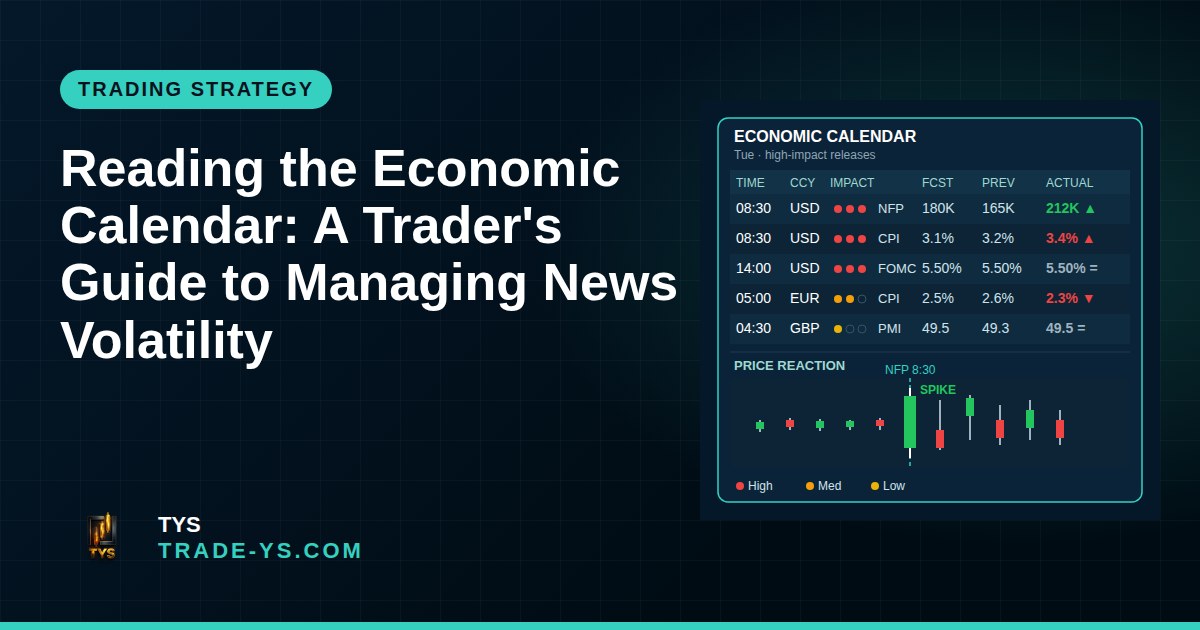
Most calendars display the same core columns:
- Time — when the release happens, in your selected time zone.
- Currency / Country — which market is most directly affected.
- Impact — usually rated with colors or stars (red/3-star = high impact, orange/2-star = medium, yellow/1-star = low).
- Forecast — the consensus estimate from economists, representing what the market has already priced in.
- Previous — the last reading for that same release.
- Actual — the real number, published at release time.
The single most important habit is comparing actual vs. forecast, not just whether the number went up or down. The market trades the surprise, not the headline.
The Releases That Matter Most
A few recurring events dominate the US calendar and ripple across indices, gold, and the dollar:
- Nonfarm Payrolls (NFP) — the monthly US jobs report from the Bureau of Labor Statistics, released on the first Friday of the month.
- CPI and PPI — consumer and producer inflation data, which shape expectations for Fed policy.
- FOMC decisions — the Federal Reserve's interest rate announcements, followed by a press conference that markets often watch as closely as the decision itself.
- PCE inflation — the Fed's preferred inflation gauge, released by the Bureau of Economic Analysis.
To put this in context: the September 2026 US jobs report, released on October 2, showed only +29,000 new payrolls against a consensus near +90,000, alongside combined downward revisions of 60,000 for the prior two months. Core PCE inflation came in at 3.0% for August, and the September jobs report showed only 29,000 new jobs. Meanwhile, at the Fed's September meeting, policymakers had already lifted rates by 25 basis points to 3.75%-4.00%, the first Fed rate hike since 2023, with all 12 voters backing it. A weak jobs print landing right after a rate hike is exactly the kind of mixed signal that confuses headline readers but rewards traders who track the calendar and the surprise gap carefully. Looking ahead, the market's next big tests are CPI on October 14, PPI on October 15, the FOMC rate decision on October 28, and the Q3 GDP/PCE releases on October 29.
How Volatility Actually Behaves Around News
A high-impact rating doesn't tell you which way price will go — it tells you a bigger-than-usual move is likely. In the first few minutes after a major release, spreads widen and price can whipsaw in both directions, so entering a new trade in that window, or holding a tight stop through it, carries outsized risk.
It's also common for price to spike one way and then reverse once the market has fully digested the data. The initial spike-and-reversal pattern occurs on roughly 55 to 60% of high-impact releases, making the first three to five minutes unreliable for directional signals. This is why many experienced traders don't try to "catch" the first candle at all.
Three Practical Rules for News Days
1. Know the schedule before the session starts. Open your calendar in the morning, note every high-impact event for the day, and write down the exact release time. Surprises come from the data, not from the clock.
2. Decide your approach in advance. There are two ways traders handle high-impact events: close or reduce positions before the release to avoid the volatility entirely, or wait for the release, let the initial spike settle, and then trade the new direction once the market has absorbed the news. Choosing beforehand keeps emotion out of a fast-moving candle.
3. Never hold a leveraged position into a major release without a plan. This is where most beginner traders get hurt — they hold a position into an FOMC decision or NFP without widening their stop loss or reducing their size, get stopped out by the spike, and then watch the market go exactly where they expected. If you choose to hold through news, know your stop level and size before the number drops, not after.
Reading Beyond the Headline
A data point rarely moves markets in isolation. Markets can also react in counterintuitive ways when a single data point conflicts with other prevailing narratives, or when a "beat" or "miss" is accompanied by revisions to the prior month's figure. That's exactly what happened with the September 2026 jobs report: the headline miss mattered, but so did the downward revisions and what it implied for the Fed's next move. Always check the surrounding data — revisions, related indicators, and central bank commentary — before assuming you understand "why" price moved.
Final Thoughts
The economic calendar won't tell you the future, but it will tell you when to be careful. For intraday traders, that's often more valuable than any indicator. Build the habit of checking it every morning, understand the forecast-vs-actual logic, and size your risk accordingly on red-folder days.
Follow TYS for ongoing Nasdaq and Smart Money Concepts breakdowns around key macro events as they unfold.
Risk reminder: This article is for educational purposes only and does not constitute financial advice. Trading involves substantial risk of loss, especially around high-impact news events, and past patterns do not guarantee future outcomes. Always manage your risk and trade with capital you can afford to lose.
