Prop Firm Challenges Explained: The Rules, How to Pass Them, and a Simple Risk Plan
What Is a Prop Firm Challenge?
A prop firm challenge (also called an evaluation or combine) is a paid test. You trade a simulated account under strict rules, and if you reach the profit target without breaking any risk rule, the firm offers you a funded account to trade with their capital instead of your own.
It sounds simple. In practice, most attempts fail — not because the trader can't find good setups, but because they misunderstand how the rules actually measure risk.
The Core Rules You Will Face
Almost every firm, whether forex/CFD or futures, builds its evaluation around the same handful of parameters:
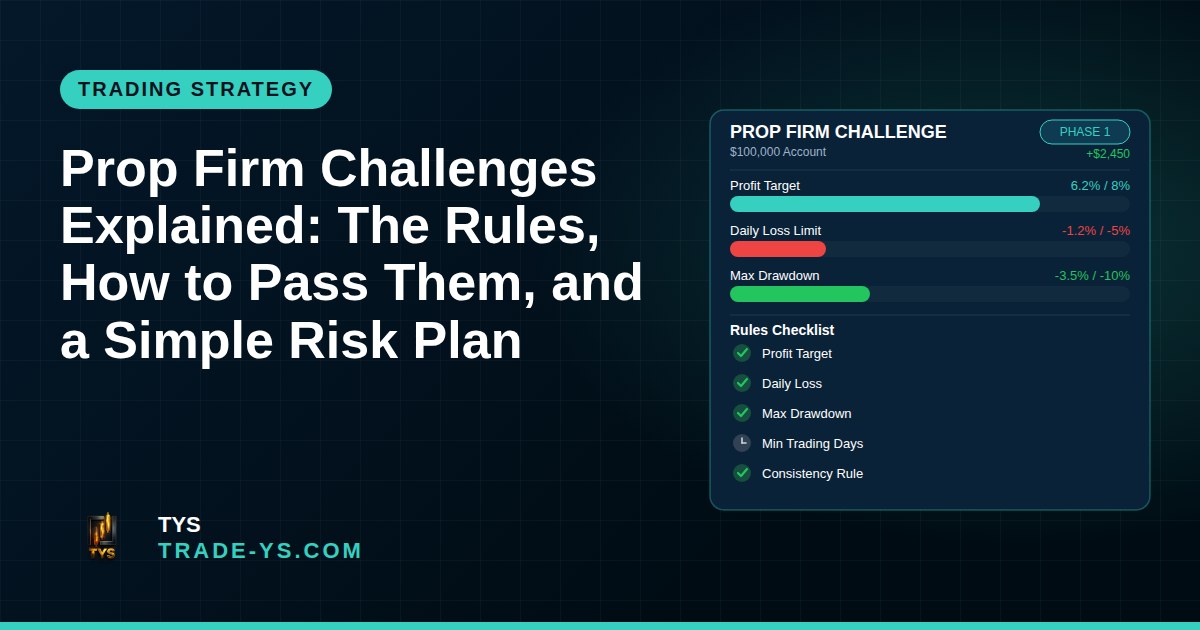
Profit target. The percentage return you must reach to pass. Industry-standard ranges sit around 8–10% for a first phase and roughly 4–5% for a second phase on two-step programs, while several futures firms now use a single-step model with a fixed dollar target.
Daily loss limit. A hard stop on how much you can lose in one calendar day. This is typically set at 4–5% of the account, and once you touch it, you're locked out for the day — it is a mechanical rule, not a suggestion.
Maximum drawdown. The overall buffer from your starting balance (or from your equity high-water mark) before the account is closed for good. Common ranges run from about 8% to 12%, and this can be "static" (fixed to the starting balance) or "trailing" (it follows your peak equity, including unrealized floating profit in some firms).
Minimum trading days and consistency rules. Many firms require a minimum number of active trading days, and a growing number add a consistency rule that caps how much of your total profit can come from a single day — often 30% to 50%. This is designed to filter out one lucky big trade and reward traders who perform steadily over time.
Why the Daily Loss Limit Trips Up So Many Traders
This rule causes more failed challenges than any other, mainly because its mechanics differ by firm. Some firms calculate the daily loss from the previous day's closing equity, others from the day's opening balance, and the loss amount usually includes the floating P&L of positions still open — not just closed trades. That means an open losing trade can push you over the limit even before you close it.
Futures prop firms add another layer: drawdown can be "trailing," meaning it follows your highest-ever unrealized equity in real time. Giving back open profit before locking it in can therefore shrink your buffer even if your account never actually lost money on paper.
The practical lesson: before risking a single dollar, read the specific firm's rule page. "5% daily loss" is not one universal rule — the measurement method changes the math completely.
A Simple Risk Plan to Approach a Challenge
You don't need a complicated system to respect these rules — you need discipline and a plan sized around the numbers above.
1. Risk a small, fixed percentage per trade. A common approach is to risk no more than 0.5–1% of the account per trade. On a $50,000 account with a 5% daily loss limit ($2,500), risking around $250–$500 per trade means it takes several consecutive losers in one day to even approach the limit.
2. Set your own internal daily "stop." Instead of trading until you touch the firm's daily loss limit, consider stopping earlier — for example at half that amount. This leaves a margin for error and avoids the psychological pressure of trading right at the edge of elimination.
3. Know your drawdown type before you trade. Check whether the firm uses static or trailing drawdown, and whether it is measured end-of-day or in real time. This changes how aggressively you can hold winning trades overnight or let them run intraday.
4. Respect the consistency rule if one applies. If your plan is to pass with one huge day, check first whether the firm caps single-day contribution to total profit. Building toward the target gradually, across several sessions, is often safer than chasing it in one trade.
5. Track minimum trading days. Some programs require a minimum number of days even if you hit the profit target early. Plan your pace so you're not forced to overtrade near a deadline just to meet a day count.
A Concrete Example
Imagine a $50,000 futures evaluation with an $2,500 trailing drawdown and a $3,000 profit target, no daily loss limit. A trader risking $300 per trade (about 0.6% of the account) with a 1:1.5 risk-reward ratio needs roughly ten net winning trades to reach target — achievable over several weeks without ever risking more than a small fraction of the drawdown buffer on any single idea. Compare that to a trader risking $1,000 per trade: two or three bad trades in a row can wipe out most of the cushion before the strategy even gets a fair test. The rules don't just test your strategy — they test your position sizing.
Before You Pay for a Challenge
- Read the firm's own rule page, not just third-party summaries — definitions of "daily loss" and "drawdown" vary between firms.
- Confirm whether the drawdown is static or trailing, and how it's calculated.
- Check for a consistency rule and a minimum trading-day requirement.
- Backtest or paper-trade your plan specifically against these constraints, not just for raw profitability.
Final Thoughts
A prop firm challenge rewards exactly what good trading already requires: small, controlled risk per trade, patience to let a plan play out over many sessions, and respect for hard stops. If your risk management already works on your own account, a challenge is a test of discipline more than of strategy. If it doesn't, the challenge will reveal that quickly — and it's far cheaper to learn that lesson on an evaluation account than on your own savings.
At TYS we regularly break down ICT and Smart Money concepts applied to Nasdaq and futures price action — if that's useful as you prepare your own trading plan, feel free to follow along with our analysis.
Risk reminder: This article is for educational purposes only and does not constitute financial advice. Trading futures, forex, and CFDs involves substantial risk of loss and is not suitable for every investor. Prop firm evaluations charge fees and carry no guarantee of passing or of future profitability. Always read a firm's full terms and conditions before purchasing an evaluation, and never risk money you cannot afford to lose.
