Position Sizing 101: How Much Should You Actually Risk Per Trade?
Why Position Sizing Matters More Than Your Entry
Most new traders spend 90% of their time looking for the "perfect" entry and almost no time deciding how many contracts or lots to trade. Yet position sizing is the one variable that decides whether a losing streak ends your account or simply shows up as a small dent in your equity curve.
Position sizing answers one question: given my stop-loss distance and my account size, how large can this trade be? Get this wrong, and even a great ICT setup can blow up your account. Get it right, and even a string of losses stays survivable.
The Core Formula
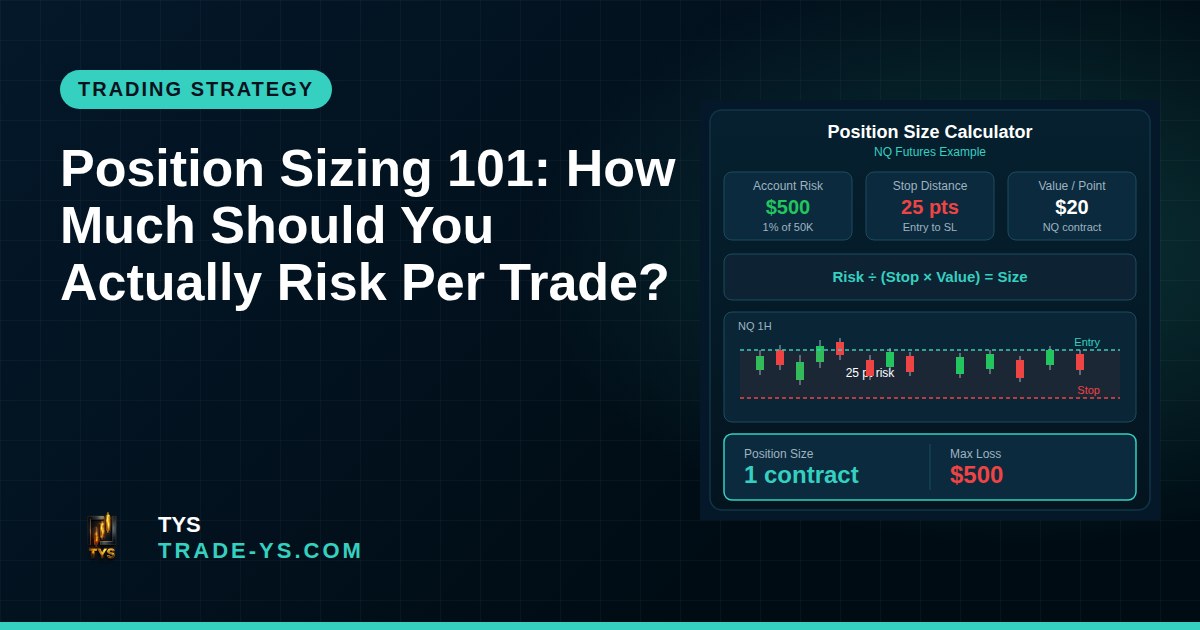
The position size calculation is simple once you know three inputs:
- Account risk – the dollar (or percent) amount you're willing to lose if the trade is wrong.
- Stop-loss distance – the distance in points/pips between your entry and your invalidation level.
- Instrument value per point/tick – how much one point of movement is worth in dollars for the contract you trade.
The formula is:
Position size = Account Risk ($) ÷ (Stop Distance × Value per Point)
Most professional risk guidelines cap risk per trade at 0.5%–2% of account equity, so that a reasonable number of consecutive losses doesn't wipe out the account.
A Concrete Example: Trading Nasdaq Futures
Let's say you trade Nasdaq-100 futures, which is a core focus of TYS analysis. CME Group lists two main versions of this contract:
- The E-mini Nasdaq-100 (NQ), where the E-mini Nasdaq-100 futures contract is $20 x the Nasdaq-100 index and has a minimum tick of 0.25 index points.
- The Micro E-mini Nasdaq-100 (MNQ), where the Micro E-mini Nasdaq-100 futures contract is $2 x the Nasdaq-100 Index and has a minimum tick of 0.25 index points.
That tenfold difference in contract value is exactly why micro contracts exist: lower margins and smaller contract size make MNQ accessible to retail traders, and it lets you fine-tune your position sizing compared to standard E-mini contracts.
Now apply the formula:
- Account size: $10,000
- Risk per trade: 1% = $100
- Your ICT-based setup has a stop-loss 40 points away from entry
- On MNQ, each point is worth $2, so 40 points = $80 of risk per contract
- Position size = $100 ÷ $80 ≈ 1 MNQ contract
If you tried the same trade on the standard NQ contract, each point would be worth $20, meaning 40 points = $800 of risk per contract — eight times your allowed risk budget on a single contract. This is exactly why the choice between NQ and MNQ is itself a risk management decision, not just a cost consideration.
Why Stop-Loss Distance Comes First
A common mistake is picking a position size first and then "making it fit" with a tight stop. This reverses the logic. Your stop-loss should sit at the level where your trade idea is actually invalidated — for example, beyond a liquidity sweep or a break of structure in an ICT setup — and your position size should adapt to that distance, never the other way around.
Leverage Is a Tool, Not a Target
Futures and forex are leveraged products, which is precisely why position sizing matters so much. Regulatory risk disclosures are blunt about this: futures trading is highly leveraged, with a relatively small amount of money used to establish a position in assets having a much greater value, and if you are uncomfortable with this level of risk, you should not trade these contracts. Leverage magnifies both outcomes equally — the high degree of leverage that is often obtainable in futures trading because of the small margin requirements can work against you as well as for you, and leverage can lead to large losses as well as gains.
In practice, this means leverage should be used to access a market efficiently (via micro contracts, for instance), not to maximize the size of every trade.
Building a Simple Position-Sizing Routine
- Define your max risk per trade in percentage terms before you even look at a chart.
- Identify your invalidation level first, then measure the stop distance.
- Choose the contract size (NQ vs MNQ, standard vs micro lot) that lets the math fit your risk budget.
- Never increase size to "make up" for a previous loss — this is how account-ending drawdowns start.
- Review your position-sizing decisions in your trading journal alongside your entries and exits.
Final Thoughts
Smart Money Concepts and ICT tools can help you find high-probability zones, but they don't protect your account by themselves. Position sizing is the bridge between a good idea and a survivable trading career. Keep your risk per trade small, let your stop-loss distance dictate your size, and use the flexibility of micro contracts to stay consistent.
Follow TYS for ongoing Nasdaq and futures market analysis as we keep breaking down these concepts in practice.
Risk reminder: This article is for educational purposes only and does not constitute financial advice. Trading futures, forex, and other leveraged products carries a high level of risk and may not be suitable for all investors. You should never risk money you cannot afford to lose, and past performance does not guarantee future results.
