How to Prepare a Trading Day: Sessions, Key Levels, and the Economic Calendar
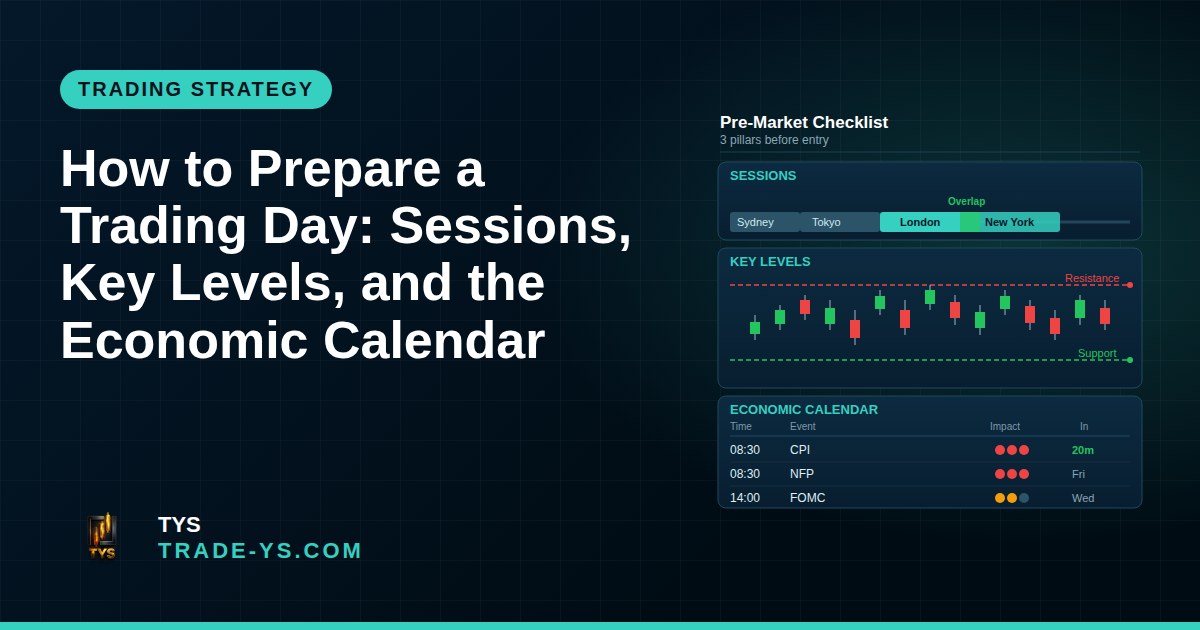
Most losing trades don't start with a bad entry. They start before the market even opens — with no plan, no levels, and no idea that a major news release is 20 minutes away. Preparation is not glamorous, but it is what separates traders who react to the market from traders who anticipate it.
Here is a simple, repeatable routine built around three pillars: sessions, key levels, and the economic calendar.
1. Know Which Session You're Trading
Price behaves differently depending on who is awake and active. If you trade futures like NQ or ES, or forex pairs, you need to know the session map before you even look at a chart.
Forex sessions run in a relay as one financial center closes and the next opens: Sydney, Tokyo, London, and New York. The London–New York overlap (13:00–17:00 GMT) carries more than half of daily volume and the tightest spreads. London alone handles 38% of global FX turnover — more than any other centre.
For index futures, the E-mini S&P 500 (ES) and E-mini Nasdaq-100 (NQ) share the same trading hours on CME Globex: Sunday 6:00 PM ET to Friday 5:00 PM ET. Within that near-24-hour window, Regular Trading Hours (RTH) run from 9:30 AM to 4:00 PM ET, aligning with U.S. stock market hours, and liquidity peaks during the market open and close, with another surge during the European-U.S. overlap from 8:00 to 11:30 AM ET.
Practical takeaway: decide in advance which window you'll actually trade. Watching charts 20 hours a day without a session filter is a fast road to overtrading.
2. Mark Your Key Levels Before the Open
Before the first candle of your session forms, you should already have your map drawn:
- Previous day's high/low — often acts as a magnet or a reaction point.
- Session opens (Asia, London, New York) — useful reference points for intraday structure.
- Overnight high/low for futures traders — where did price trade while you were asleep?
- Weekly/monthly open and prior week's high/low — larger-picture liquidity pools.
- Any untapped order blocks or fair value gaps left from the previous session.
None of this requires an indicator. It requires five minutes with a blank chart and a pencil mindset: where did price react last time, and where might smart money be hunting liquidity today?
Example: Say NQ closed Thursday's regular session near a prior day's high, with an unfilled fair value gap just below it. A trader who marked that level the night before isn't surprised when price opens Friday, sweeps that high, and reverses — they were watching for exactly that reaction instead of chasing the breakout.
3. Check the Economic Calendar — Every Single Day
Even the cleanest technical setup can be destroyed by a scheduled news release. This is non-negotiable prep, not optional.
The single most-watched monthly event is the U.S. jobs report. The Employment Situation is released by the Bureau of Labor Statistics (BLS) at 8:30 a.m. ET on what is usually the first Friday of every month. However, the "first Friday" label is only a guideline, not a guarantee — in 2026, for example, one report shifted to the second Friday of the following month. That's exactly why you check the calendar yourself rather than assuming.
Other recurring high-impact releases include CPI (inflation), FOMC interest rate decisions and press conferences, PPI, and retail sales — all of which can trigger sharp, fast moves. Major US economic data such as NFP, CPI, and FOMC decisions are often released during the London-New York overlap, making it one of the most important windows for active traders to watch.
Practical takeaway: every morning, before placing a single trade, open a free economic calendar (Forex Factory, Investing.com, or the official BLS/Fed calendars) and note:
- What's scheduled today, and at what time (in your local timezone)?
- Is it high, medium, or low impact?
- Does it affect the instrument you trade (USD news affects NQ/ES too, since they're dollar-denominated)?
If a red-flag event lands near your usual entry window, many traders simply choose to stand aside, or widen their risk expectations and reduce size.
Putting It Together: A Simple Pre-Market Checklist
- Session — which window am I trading today, and is liquidity typically high or low right now?
- Levels — previous day high/low, session opens, overnight range, weekly open, any open order blocks or FVGs.
- Calendar — any red-flag news today? At what time, exactly?
- Bias — based on structure and levels, what's my rough directional idea, and where would that idea be invalidated?
- Risk — what's my max risk for the day if things don't go to plan?
Five minutes of this routine, done consistently, builds the kind of context that turns random entries into informed ones.
Final Thought
Preparation doesn't guarantee a winning day — nothing in trading does. But trading without knowing the session, the levels, or the calendar is like driving in fog without headlights. Build the habit, keep it simple, and let the market come to your plan instead of chasing it.
If you want to see this kind of session-by-session and pre-market breakdown applied live on Nasdaq futures, feel free to follow TYS's daily analysis.
Risk reminder: Trading futures and forex involves substantial risk of loss and is not suitable for every investor. This article is for educational purposes only and does not constitute financial advice. Past patterns do not guarantee future results — always manage your risk carefully.
