Hot CPI, Hawkish Fed: How September's Inflation Report Shook Indices and Gold Ahead of the October Decision
Why This Week Mattered
Every trader knows the economic calendar has a few "red-flag" days that can move markets more than an entire normal week. This week delivered one of them: the US Consumer Price Index (CPI) report for September.
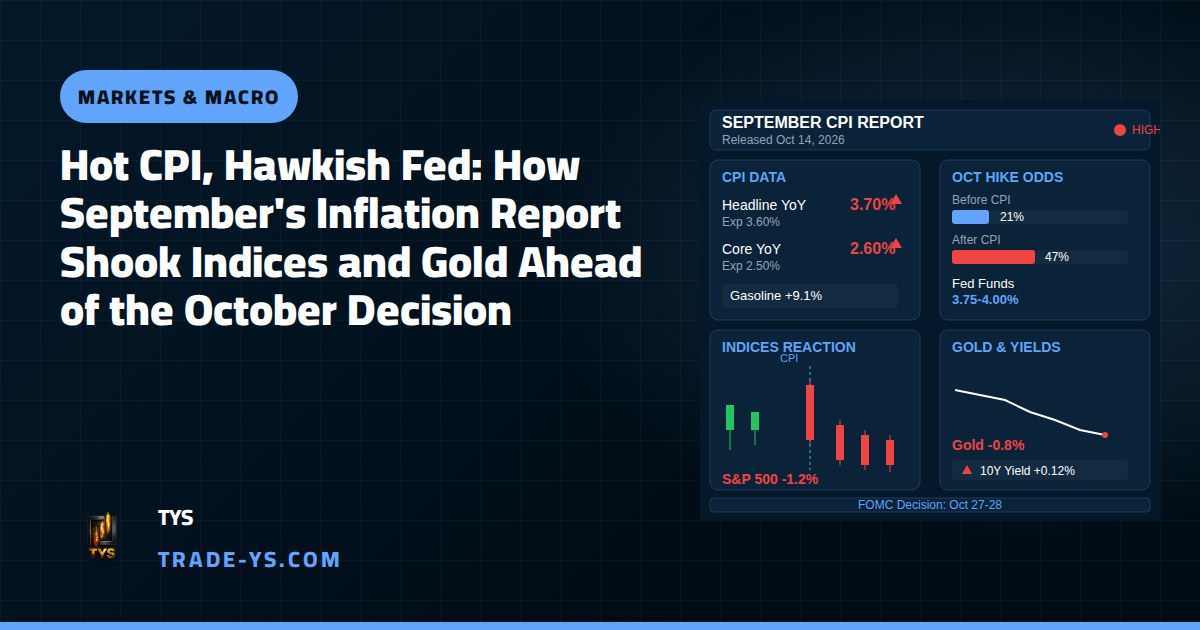
Released on October 14, 2026 by the Bureau of Labor Statistics, the report showed headline inflation accelerating to 3.70% year-over-year, above the 3.6% consensus, while core inflation (excluding food and energy) rose 2.60% year-over-year, also hotter than the 2.5% expected. Roughly half of the monthly gain came from a 9.1% jump in gasoline prices.
That single data point reshaped expectations for the Federal Reserve's next move — and dragged indices and gold along with it.
From CPI to the Fed: Why the Link Matters
The Fed had already raised its target rate by 25 basis points at the September 15–16 meeting, lifting the federal funds range to 3.75%–4.00%, its first hike since 2023, citing elevated inflation and a need for a timelier return to the 2% goal.
Going into this week's CPI release, markets were pricing only about a 21-22% chance of another hike at the upcoming October 27–28 FOMC meeting. Within minutes of the hot print, that probability jumped sharply, with one market strategist noting the odds of an October hike rising to roughly 47% and the priced tightening for the rest of the year increasing accordingly.
This is the core mechanism every trader should understand: hotter inflation data raises the odds of tighter Fed policy, and tighter policy expectations push Treasury yields and the dollar up — which in turn pressures both equities and gold, at least in the short term.
How Indices Reacted
US stock indices fell on the day. The S&P 500 dropped about 1.11%, the Nasdaq Composite lost around 1.88%, the Dow Jones Industrial Average slipped roughly 0.09%, and the Russell 2000 declined close to 1.93%, with technology and communication services among the hardest-hit sectors.
The move illustrates something ICT and Smart Money traders talk about often: news doesn't just create volatility, it can trigger a shift in the dominant narrative. A report that beats expectations on inflation effectively tells the market "the Fed may need to stay restrictive for longer," and growth-sensitive, rate-sensitive sectors like tech typically feel that first and hardest.
Treasury yields moved in sympathy. The 10-year yield climbed toward 5.2% on the print before easing slightly later in the session, while the 2-year yield — which tracks Fed expectations closely — also pushed higher.
How Gold Reacted
Gold's reaction followed the textbook script for a hot inflation surprise paired with rising rate-hike odds. Spot gold, which had been holding near $4,150–$4,160 ahead of the release, fell within minutes of the data, dropping from around $4,153 to roughly $4,100–4,117 an ounce in the same short window, before continuing to slide through the day toward the $4,140s.
The logic: higher expected interest rates raise the "opportunity cost" of holding a non-yielding asset like gold. When real yields rise, gold tends to come under pressure, even though many investors still view it as a long-term inflation hedge. Analysts at TD Securities noted that systematic trend-following funds had turned heavy sellers of gold once the hot print landed, especially with price already meeting resistance near the $4,200 level in prior sessions.
It's worth noting gold had already pulled back notably from its highs in the weeks before this report, so the CPI reaction added to an existing short-term corrective move rather than starting a new trend on its own.
A Concrete Example
Imagine a trader watching gold into the 8:30 a.m. ET CPI release. Price was consolidating just below $4,150. The report crosses the wire: headline CPI beats forecast. Within the first one-to-two minutes, gold sweeps recent lows as algorithmic and discretionary sellers react to the same headline simultaneously — exactly the kind of liquidity grab that ICT concepts describe around high-impact news. A trader who had already marked key support zones and was waiting rather than guessing had a much clearer read on where price might react than someone caught flat-footed by the headline.
This is why reading the calendar in advance, knowing the forecast number, and having levels marked ahead of time matters more on days like this than on an average Tuesday.
What's Still Ahead
The story isn't over. The next major test is the FOMC decision on October 27–28, where the base case among economists remains a "hawkish hold" — rates unchanged, but language that keeps a December hike firmly on the table. September's Producer Price Index and Retail Sales data, released the day after CPI, added further pieces to that puzzle, and the next CPI report (for October data) isn't due until mid-November.
Until the Fed speaks again, expect indices and gold to stay sensitive to every new data point and every Fed official's comment, as markets continue to debate whether this inflation pop is a temporary, energy-driven blip or a more persistent trend.
Risk Reminder
This article is for educational purposes only and is not financial advice. Markets around high-impact news events like CPI and FOMC decisions can be extremely volatile, with fast, unpredictable price swings in both directions. Always use proper position sizing, predefined stop-losses, and never risk more than you can afford to lose. Past price reactions do not guarantee future ones.
If you'd like to follow how TYS reads these macro events on NQ, ES, and gold charts in real time, keep an eye on our upcoming analysis.
