Discipline Over Emotion: Beating Revenge Trading and Overtrading
Why Psychology Decides More Than Strategy
You can have a solid ICT-based reading of market structure, a clean order block, and a well-defined risk plan — and still blow up your account. Not because the setup was wrong, but because of what happened after the first loss.
This is the part of trading nobody shows on social media: the moment you're staring at a red number, chest tight, finger hovering over the "buy" button again. That moment decides more about your long-term survival than any indicator ever will.
What Revenge Trading Really Is
Revenge trading is taking trades — usually quickly, with larger size, against your normal rules — specifically to recover a recent loss, driven by emotion, not strategy. It's not a strategy mistake. It's an emotional hijack.
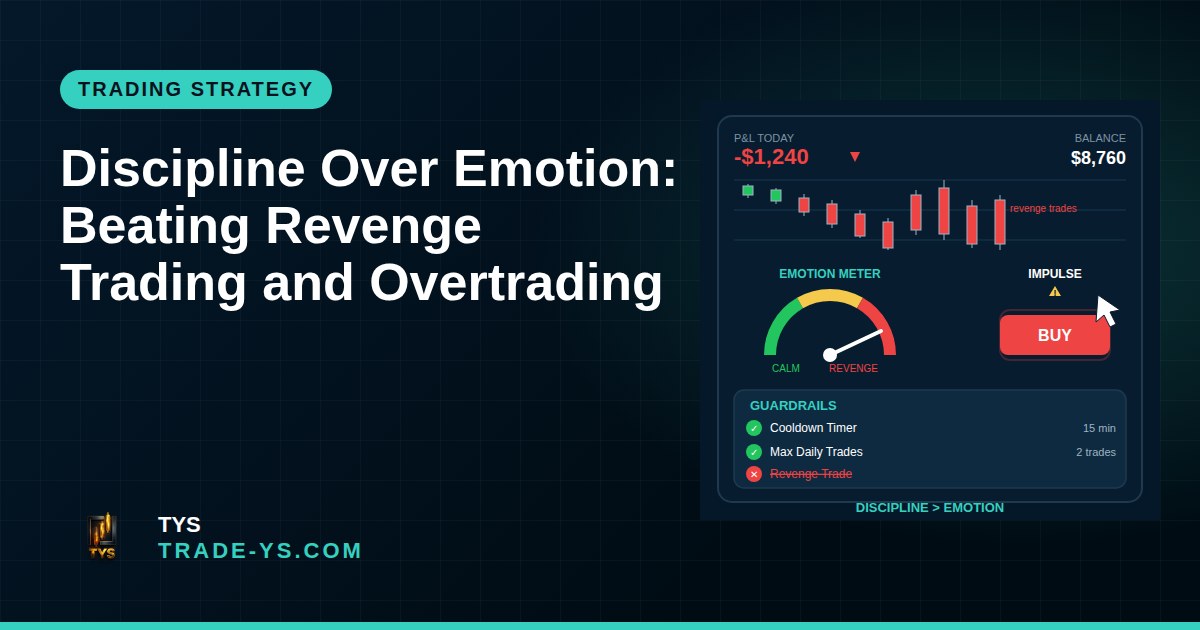
The pattern is almost always the same: instead of waiting for a clear setup or following a strategy, the trader rushes into new trades — often larger, riskier, and poorly thought out, doubling position sizes after a loss, ignoring stop-loss levels, jumping into trades out of frustration or fear.
Why does this happen to almost everyone at some point? Behavioral finance gives a clear answer. We feel losses roughly twice as intensely as equivalent gains — a loss doesn't just sting, it creates an almost physical urge to make that pain go away, which often overrides logical thinking. This asymmetry isn't a personal weakness unique to you — Kahneman and Tversky's prospect theory (1979) showed that this asymmetry is hardwired into human decision-making.
On top of loss aversion, there's ego. Revenge trading is rooted in ego, loss aversion, and fear — many traders can't stand being "wrong," so they try to prove themselves right. And there's a biological layer too: the brain genuinely treats a losing trade as a threat, triggering a fight-or-flight response where "fight" means jumping back into the market to neutralize the discomfort — a survival instinct that produces the worst possible outcomes in a trading environment.
Overtrading: The Quiet Account Killer
Overtrading doesn't always look dramatic. Sometimes it's just... too much activity. Overtrading is the act of trading more often than your strategy or market conditions justify — placing too many trades in a single session, trading every small price movement, or increasing position sizes without a valid reason.
Importantly, overtrading isn't really about a specific number of trades. It means taking trades that fall outside your trading plan, risk limits, or entry criteria — it is not defined by the number of trades you take but by whether each trade is justified by a valid, pre-defined setup. A trader taking thirty valid setups in a scalping system isn't overtrading; a trader taking one impulsive trade with no edge is.
The causes are rarely purely technical. The main causes are impatience, revenge trading, boredom, or overconfidence. And the consequences compound quietly. Neither form of overtrading produces immediate collapse in most cases — the damage accumulates gradually, which makes it easy to dismiss early warning signs.
There's also a hard, measurable cost beyond emotion: every extra trade means extra spread, extra commission, extra slippage. Studies of retail brokerage accounts have found that average round-trip trading costs run roughly 5 to 6%, meaning a trader needs to outperform by that margin on every switch just to break even.
A Concrete Example
Imagine a trader risking 1% per trade on NQ futures with a clear ICT-style plan: wait for a liquidity sweep, confirm a market structure shift, enter at a fair value gap. First trade of the day hits the stop — a normal, planned loss.
Instead of stepping away, the trader feels the sting, opens a new chart, and takes a trade without waiting for the same confirmation — this time with double the size "to get it back faster." That trade also fails. Now a single planned 1% loss has become a 3% loss, and the trader's remaining decisions for the day are being made from frustration, not from the plan. This is the exact mechanism described above: one bad reaction compounding a normal, survivable loss into a damaging one.
Recognizing the Warning Signs
Some signals that discipline is slipping, drawn from how brokers and trading educators describe it:
- Increasing trade size after losses, trading more frequently as an emotional reaction, feeling compelled to have a position open at all times.
- Trading right after a loss with bigger size or higher frequency, ditching your strategy to "make back" what you just lost, getting emotionally attached to breaking even for the day.
- Checking the chart obsessively between trades, hoping the market will hand you an instant recovery.
Building Guardrails
None of this requires becoming emotionless — that's not realistic. It requires structure that holds even when emotion is loud.
1. Define your plan before the session, not during it. Entry criteria, stop-loss, position size — decide these when you're calm, not when you're already in a trade.
2. Set a daily loss limit and a trade-count limit. If you hit either, you're done for the day — no debate with yourself.
3. Build in a pause after any loss. Even five minutes away from the screen interrupts the fight-or-flight reflex and gives your rational brain a chance to re-engage.
4. Journal every trade, especially the ones that broke your rules. A pattern of "I entered because I was angry" is the clearest signal that your next step should be a break, not a bigger position.
5. Separate recovery from the next session. Markets don't owe you a win-back trade today. There's always tomorrow's session.
Final Thought
Discipline isn't glamorous and it doesn't show up on a P&L screenshot — but it's the one edge that compounds every other skill you build. The traders who last aren't the ones who never feel the urge to revenge trade; they're the ones who built a system strong enough to survive the moments they do.
If you want to see how discipline and structure apply to real ICT-based Nasdaq and futures setups, follow along with TYS's ongoing market analysis.
Risk reminder: This article is for educational purposes only and does not constitute financial advice. Trading futures, forex, and other leveraged instruments carries a high level of risk and can result in losses exceeding your initial deposit. Past performance does not guarantee future results. Always do your own research and consider your risk tolerance before trading.
