Different types of Financial Markets
Financial markets play a crucial role in the functioning of the global economy. They provide an efficient way for companies and governments to raise capital, and they allow investors to diversify their portfolios and potentially earn higher returns. However, financial markets can also be volatile, and investing in them carries a certain level of risk. It is important for investors to educate themselves about the different types of financial markets and to understand the potential risks and benefits before participating in them.
/wp-content/uploads/2023/03/what-is-shoty-order.png
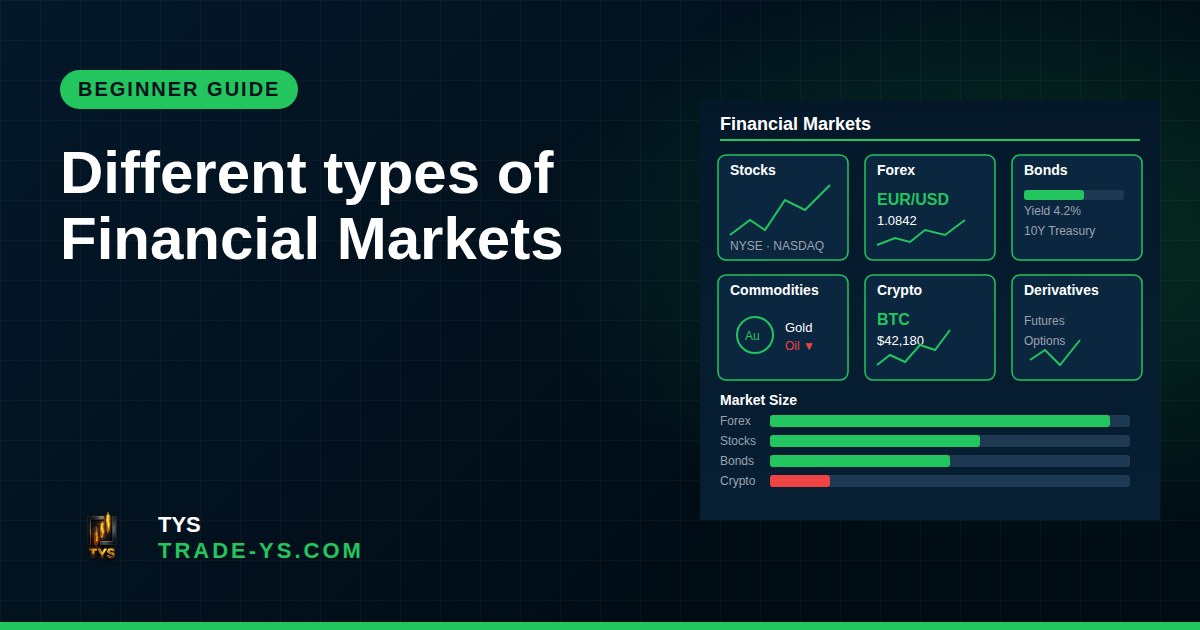
There are several types of financial markets where investors can make transactions:
- Stocks: A stock represents a share in the ownership of a company. When you buy a stock, you become a part-owner of the company and are entitled to a portion of its profits, as well as having a say in important company decisions through voting rights at shareholder meetings. Stocks are traded on stock exchanges such as the NASDAQ and the NYSE. The value of a stock can rise and fall based on the performance of the company and the overall market conditions.
- Currencies: The foreign exchange (Forex) market is the largest financial market in the world, where currencies are bought and sold. Investors can trade currency pairs, such as the US dollar and the euro, in an attempt to profit from changes in exchange rates. The Forex market operates 24 hours a day, five days a week, as currency trading is conducted electronically around the world.
- Commodities: The commodity market is where raw or primary products are traded, such as gold, silver, oil, wheat, and corn. These markets are usually subject to supply and demand pressures, as well as other economic, political, and environmental factors. For example, changes in oil production levels or weather conditions can impact the price of agricultural commodities.
- Bonds: Bonds are debt securities issued by governments, corporations, and other organizations to raise funds. When you purchase a bond, you are essentially lending money to the issuer in exchange for periodic interest payments. At the end of the bond’s term, the principal amount is returned to the bondholder. The bond market is considered to be less risky than the stock market, but there is still a chance of default by the issuer, which would result in the bondholder losing their principal investment.
- ETFs (Exchange Traded Funds): ETFs are investment funds that are traded on stock exchanges like individual stocks. ETFs hold a basket of assets, such as stocks, bonds, or commodities, and aim to track the performance of a particular index or market segment. By investing in an ETF, an investor can gain exposure to a diversified portfolio of assets in a single trade.
- Options: An option is a contract that gives the holder the right, but not the obligation, to buy or sell an underlying asset, such as a stock, at a specified price within a specified time period. Options trading can be used for hedging purposes or for speculation, but it is a complex and risky investment product. Options traders must have a deep understanding of the market and the underlying asset, as well as the ability to correctly predict market movements.
- Futures Market : The market of futures is a financial market on which investors can buy and sell futures contracts, which are agreements between two parties to buy or sell an asset at a fixed price at a future date. Futures contracts can be on commodities, such as oil, wheat, or gold, or on financial products, such as stocks or currencies.
It is important to remember that each financial market type carries its own unique risks and benefits, and it is important to understand these before making any investment decisions. Seeking the advice of a qualified investment advisor is always recommended.
Focus on Futures Markets:
A futures market is a platform where individuals and institutions can trade futures contracts, which are agreements to buy or sell a specific asset at a predetermined price and date in the future. Futures contracts are typically used for commodities, such as agricultural products, energy, and precious metals, but they can also be used for financial instruments, such as currencies and stock indices.
When a buyer enters into a futures contract, they are essentially betting on the price of the underlying asset to increase, while a seller is betting on the price to decrease. The price of a futures contract is determined by supply and demand, and it can fluctuate up until the contract’s expiration date.
There are two main types of participants in the futures market: hedgers and speculators. Hedgers are individuals or institutions that use futures contracts to reduce the risk of price movements in the underlying asset. For example, a farmer may sell futures contracts on their crops to lock in a price and reduce the risk of a price decline by the time they are ready to sell their crops in the future. On the other hand, speculators are individuals or institutions that use futures contracts to make a profit from price movements in the underlying asset. They do not actually plan to take physical delivery of the asset, but rather profit from the price difference between the futures contract’s purchase and sale.
Futures contracts are traded on organized exchanges, such as the Chicago Mercantile Exchange or the Intercontinental Exchange, and they are standardized in terms of the underlying asset, the quantity, and the expiration date. The futures market is highly regulated to ensure fairness and transparency, and it is monitored by government agencies, such as the Commodity Futures Trading Commission (CFTC) in the United States.
It is important to note that the futures market can be highly volatile, and investing in futures contracts carries a high level of risk. Futures contracts can involve significant leverage, meaning that a small movement in the price of the underlying asset can result in large losses or gains. As a result, it is crucial for individuals to understand the mechanics of the futures market and the risks involved before participating in it.
Conclusion :
In conclusion, financial markets are platforms where investors can buy and sell financial assets such as stocks, currencies, commodities, bonds, exchange-traded funds, and options. Each of these market types has unique characteristics and risks, and it is important for investors to understand the financial products they are investing in and the potential risks involved before making an investment decision. Investors can also consult with a qualified investment advisor for additional help.