Common Mistakes Beginner Traders Make (And How to Avoid Them)
Why So Many Beginners Struggle
Trading looks simple from the outside: watch a chart, click buy or sell, collect profit. In reality, the numbers tell a different story. Regulators that require brokers to publish client results consistently find that a large majority of retail accounts end up losing money. The European Securities and Markets Authority (ESMA), for example, has found that between 74% and 89% of retail CFD accounts lose money, with average losses ranging from €1,600 to €29,000 per client over the reporting period. The UK's FCA reports similar figures.
The good news: most of these losses don't come from "the market being rigged." They come from a short list of repeated, avoidable mistakes. Let's go through them one by one.
Mistake 1: Trading Without a Plan
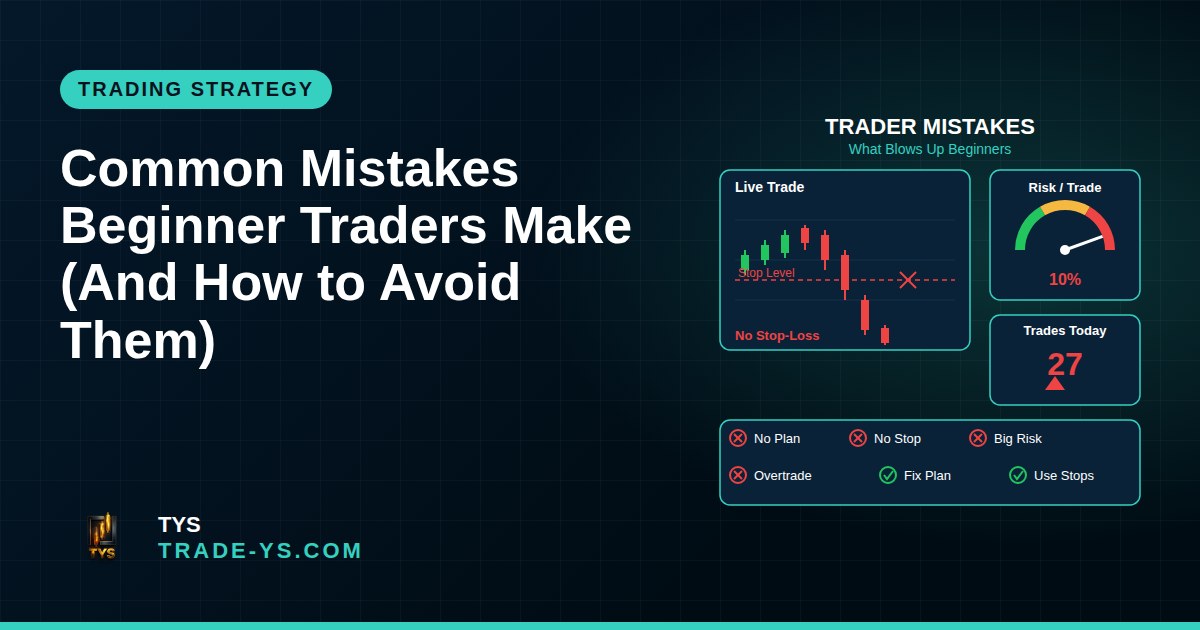
Many beginners open a chart, feel a hunch, and click. There's no written entry rule, no target, no invalidation point. Start by building a simple trading plan. Define your preferred market, timeframes, and strategy. Decide in advance how much of your capital you are willing to risk per trade. A plan doesn't guarantee a winning trade — it guarantees you know why you took it, which is what lets you actually learn from the outcome.
Mistake 2: Skipping the Stop-Loss
This is one of the fastest ways to blow an account. Not using a stop-loss is also a major mistake beginner traders make, and it completely undermines risk management — your risk becomes the amount you have put in, and a few of these trades could easily blow your account. A stop-loss isn't a sign of weak conviction; it's the line between a manageable loss and an account-ending one.
Mistake 3: Risking Too Much on a Single Trade
It's tempting to go big when you feel confident. But committing too large a portion of capital to one trade means a losing trade can cause significant damage that is genuinely difficult to recover from. That's why a widely used guideline is to risk only a small, consistent percentage of total capital per trade, often cited at around 1–2%, which lets traders absorb a run of losing trades without disrupting their ability to keep trading — the exact percentage matters less than applying it consistently.
Concrete example: Imagine a trader with a $2,000 account who risks 1% ($20) per trade instead of 10% ($200). After five losing trades in a row — which happens to everyone eventually — the disciplined trader still has about $1,900 left and can keep operating. The trader risking 10% per trade is down to roughly $1,180 and now needs a much bigger percentage gain just to get back to even. Same five losses, very different outcomes.
Mistake 4: Overtrading
Overtrading is entering far more trades than your strategy actually justifies, often to "stay busy" or to chase every move. Overtrading occurs when traders enter too many positions in a short period, often without strong trade setups. This behavior increases transaction costs and exposes traders to unnecessary risk. It frequently starts with emotion rather than analysis: overtrading often comes from impatience or emotional reactions — a loss stings, so you take another trade to "fix" it, or a busy market feels like you have to trade. But more trades don't always mean more profits. Capping yourself to a small number of high-quality setups per day keeps costs and emotional fatigue under control.
Mistake 5: Holding Losers Too Long, Hoping They "Come Back"
Closing a loss feels bad, so many beginners simply... don't. Another common mistake is refusing to accept losses — traders sometimes hold losing positions in the hope that prices will eventually recover. However, small losses can quickly grow into large losses if positions are not managed properly. This is exactly why a predefined stop-loss, decided before you enter the trade, removes the need to make that painful decision in the heat of the moment.
Mistake 6: Chasing Breakouts and FOMO Entries
Jumping into a move because it "looks like it's going higher" is one of the oldest traps around. Picture a stock smashing through a resistance level with huge volume — you think "it's going higher!" and buy in, then the price reverses, leaving you stuck. Breakouts look like opportunities, but they're frequently setups by big players. This is part of why ICT and Smart Money concepts emphasize understanding liquidity and market structure before entering, rather than reacting to the first burst of momentum.
Mistake 7: Letting a Winning Streak Create Overconfidence
Ironically, wins can be as dangerous as losses for a beginner. After a few winning trades, confidence can quickly turn into overconfidence. This often leads to larger positions and unnecessary risks. Treating every trade — win or lose — as a fresh, independent decision governed by the same rules is one of the simplest ways to stay consistent.
Mistake 8: Not Keeping a Trading Journal
Without a record of what you did and why, it's nearly impossible to spot your own recurring errors. A simple journal — entry, exit, reasoning, and how you felt during the trade — turns random experience into actual, reviewable data you can learn from over time.
Putting It Together
None of these mistakes are exotic. They're the same handful of habits — no plan, no stop-loss, oversized risk, overtrading, holding losers, chasing entries, overconfidence, and no journal — showing up across almost every account that struggles. Fixing even two or three of them (starting with the stop-loss and position size) already removes most of the damage.
A Short Risk Reminder
Trading and investing involve substantial risk of loss and are not suitable for every individual. Past performance and educational examples do not guarantee future results. Nothing in this article is financial advice — always do your own research and, if needed, consult a licensed professional before making any trading decision.
If you'd like to see how these principles apply to real setups on the Nasdaq and other markets, feel free to follow TYS's ongoing analysis and breakdowns.
