Beyond the Basics: The Hidden Mistakes That Still Sabotage Beginner Traders
Beyond the Basics: The Hidden Mistakes That Still Sabotage Beginner Traders
Most beginners already know they shouldn't "overtrade" or "trade on emotions." They've read the articles, watched the videos, maybe even memorized the ICT glossary. Yet the losses keep coming.
That's because the mistakes that quietly end accounts aren't always the obvious ones. This article looks at the mistakes that show up after the basics are learned — the subtle habits that trip up traders who think they're past the beginner stage.
The Scale of the Problem
Before getting into specifics, it's worth remembering how common failure actually is. Regulatory data is consistent across markets: various studies and broker reports suggest that 70%-90% of retail forex traders end up losing money over time, with an ESMA report finding between 74%-89% of retail traders lose money trading CFDs and forex. In India, a regulator study found that in fiscal year 2024, 91.1% of retail traders made losses while trading in derivatives, and a separate SEBI study noted that 89 per cent of individual traders in the equity F&O segment incurred losses. These numbers don't mean trading is impossible — they mean most people repeat the same avoidable errors.
Mistake 1: Knowing the Concepts, But Not the Execution
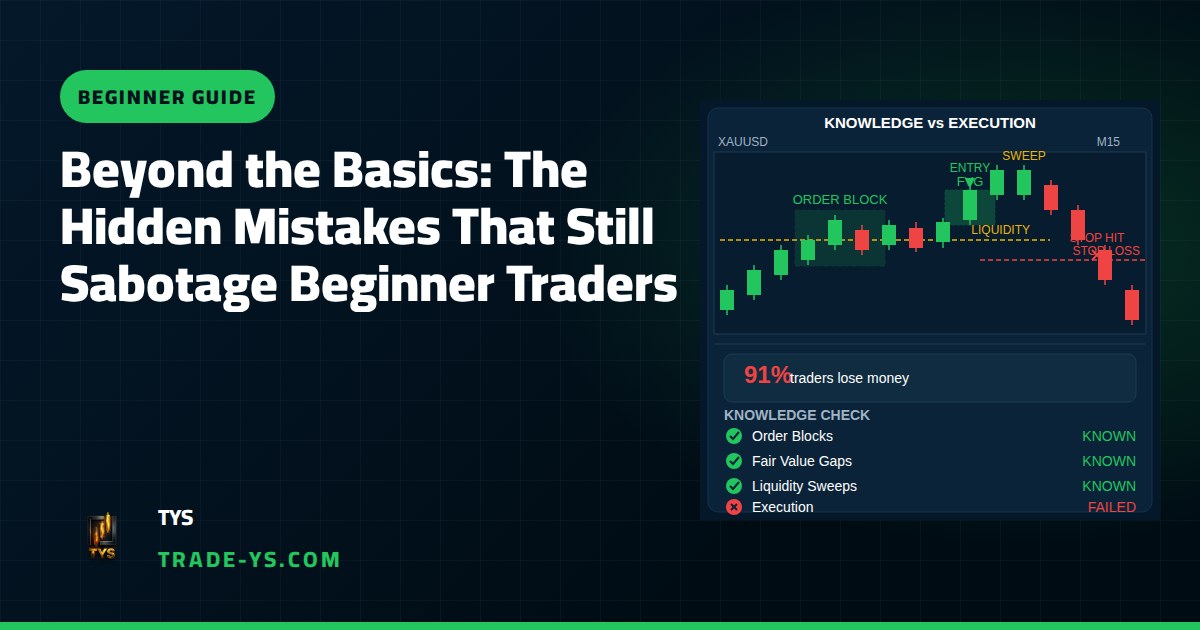
A trader can explain order blocks, fair value gaps, and liquidity sweeps perfectly — and still lose money. Understanding a concept intellectually is not the same as executing it under pressure, with real money, on a moving chart. The gap between "I know this setup" and "I can take this setup calmly" is where many accounts leak out. The fix is simple but unglamorous: hundreds of screen hours and a journal, not more theory.
Mistake 2: Strategy-Hopping Before Any Strategy Gets a Fair Test
After one or two losing trades, many beginners assume the strategy is broken and jump to a new one — a new indicator, a new session, a new mentor's method. The journey from beginner to consistently profitable trader is not defined by genius; it's defined by discipline, and the major reasons most traders fail include lack of a plan, poor risk management, emotional trading, overtrading, and failure to learn. Constantly switching systems means never collecting enough sample size to know if anything actually works.
Mistake 3: Treating Every Session as a Trading Opportunity
New ICT-style traders often feel they need to watch every killzone — London, New York, Asia — and take a trade in each one. This isn't dedication, it's a disguised form of overtrading. Overtrading, entering too many positions or trading too frequently, usually stems from impatience, boredom, or the urge to recover losses quickly, and it reduces focus while increasing transaction costs. A selective trader who takes two high-quality setups a week will usually outperform one who forces five mediocre ones a day.
Mistake 4: Sizing Up on "High Confidence" Setups
A dangerous habit: risking the normal 1% on most trades, then suddenly risking 4-5% because a setup "looks perfect." Confidence is not the same as certainty — no setup is guaranteed. A sound approach is to never risk more than 1–2% of the account on a single trade, use stop-loss and take-profit orders consistently, and think in terms of risk-to-reward ratios rather than just potential profits. One oversized "sure thing" that goes wrong can undo weeks of careful, consistent trading.
Mistake 5: No Plan for the Demo-to-Live Transition
Many beginners trade a demo account flawlessly, then fall apart the moment real money is on the line. The charts are identical — the psychology is not. Skipping a gradual transition (small live size first, same rules, same journal) is a common reason good demo traders become poor live traders.
A Concrete Example
Imagine a trader who understands market structure shifts and liquidity sweeps well on paper. During the New York lunch session — typically low in liquidity and prone to choppy price action — they see a setup that resembles their textbook example and take it with double their normal size, convinced it's an "A+ trade." Price whipsaws, stops them out, and they immediately re-enter to "get it back." The mistake wasn't the concept; it was trading a thin-liquidity window, oversizing on conviction, and revenge-entering afterward. Three separate habits, one single loss.
How to Actually Fix These Habits
- Journal every trade, including the reason for entry and the size used — not just the outcome.
- Pick one strategy and test it over a meaningful number of trades before judging it.
- Define your sessions in advance and only trade the windows your plan actually covers.
- Keep position sizing mechanical, not emotional — the same risk percentage regardless of how "sure" you feel.
- Treat the first weeks of live trading as a transition phase, with reduced size, not a test of willpower.
Final Word
None of this guarantees profits — trading futures, forex, or any leveraged product carries a real risk of loss, and most retail traders do lose money over time. This article is educational content, not financial advice, and past patterns don't guarantee future results.
If you want to see how these ideas apply to real Nasdaq and S&P futures price action, follow TYS's ongoing analysis — it's a useful way to watch the concepts in motion rather than just in theory.
