After the Loss: The 15-Minute Rule That Can Save Your Trading Account
After the Loss: The 15-Minute Rule That Can Save Your Trading Account
Every trader knows the feeling. The stop gets hit, the candle keeps running in "your" direction without you, and within seconds your thumb is already hovering over the buy button again. That single impulse — the urge to get back in right now — is responsible for more blown accounts than any bad strategy ever will be.
This article looks at why that urge is so powerful, what the research actually says about the speed of re-entry after a loss, and one simple, concrete rule you can build into your routine to interrupt the cycle before it interrupts your account.
It's Not the Loss, It's What You Do Next
Losing trades are a normal part of any strategy with an edge. The problem isn't the loss itself — it's the decision made in the minutes right after it.
Revenge trading is the act of entering impulsive, emotionally driven trades immediately after a loss, with the primary motivation of recovering that loss rather than executing a well-reasoned strategy. It is not simply "trading after a loss." Experienced traders take losses constantly, but revenge trading is distinguished by its emotional signature: the trader is no longer making decisions based on edge, they are making decisions based on pain.
The mechanism behind this is well documented in behavioral economics. Loss aversion is one of the most established findings in behavioural economics, from the work of Kahneman and Tversky: a loss of a given amount produces more emotional pain than the pleasure of gaining the same amount, with the asymmetry roughly two to one. After a loss, the brain doesn't register a neutral outcome — it registers a deficit that feels urgent to correct.
Speed Matters More Than You Think
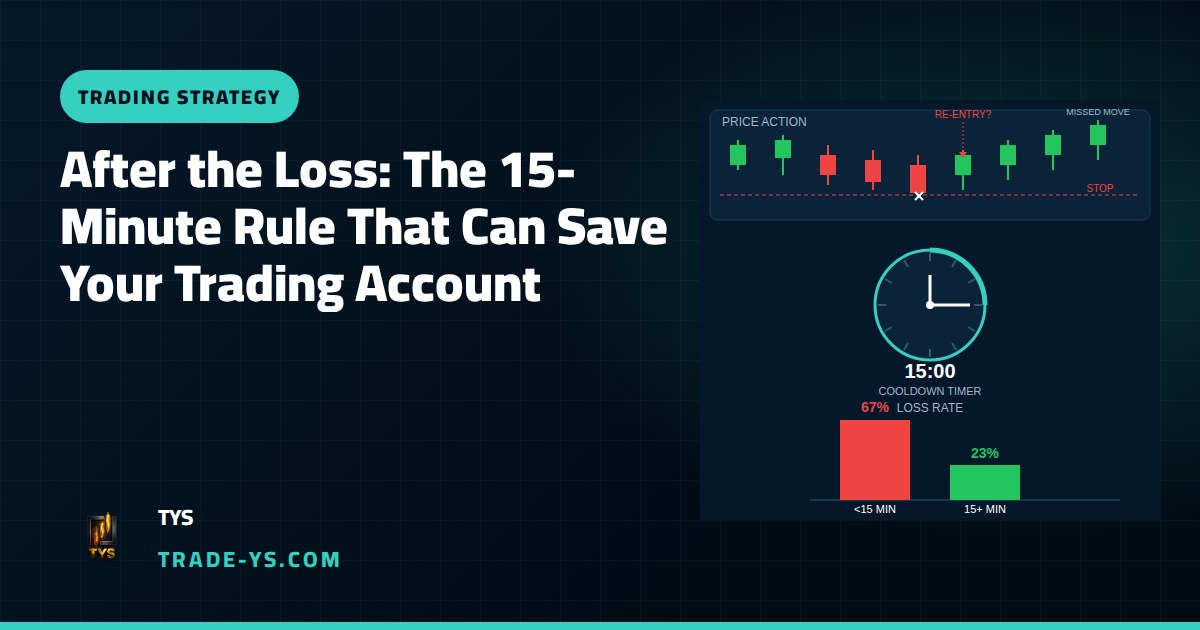
If you've ever wondered whether jumping back in quickly is really that dangerous, researchers have actually measured it. A 2020 study published in the Journal of Behavioral and Experimental Finance found that traders who executed trades within 10 minutes of closing a losing position had a 63% probability of that follow-up trade also being a loser, compared to a roughly 47% loss rate on trades entered under normal conditions. The speed of re-entry was a stronger predictor of negative outcomes than the size of the initial loss itself.
That's a striking detail. It isn't the setup, the pair, or the size of the previous loss that predicts the next outcome best — it's simply how fast you climbed back in. The faster the re-entry, the more the decision is being driven by emotion rather than analysis.
There's a biological reason for this delay being so protective. The simplest and most effective remedy for revenge trading is time — research on emotional recovery shows that 15 to 30 minutes is often enough to let the amygdala calm down and the prefrontal cortex reboot. In plain terms: the part of your brain that reacts emotionally needs a short window to settle before the part that reasons and follows a plan can take back control.
Overtrading Isn't Only a "Loss" Problem
Revenge trading is one face of overtrading, but it isn't the only one. The broader pattern — taking more trades than your edge or your plan actually calls for — is costly on its own, even without any anger involved.
The clearest evidence for this comes from one of the most cited studies in behavioral finance. Barber and Odean (2011) analyzed 78,000 US brokerage accounts from 1991 to 1996 and found that the most active 20% of investors earned 11.4% annually net of costs versus 18.5% for the least active 20% — a 7 percentage-point gap. The main driver wasn't bad luck; it was an annual turnover of 258% for the most active group, which eroded returns through costs and poor timing. Overconfidence, boredom, and the need to "always be in a trade" are just as damaging as anger-driven revenge trades, just quieter about it.
A Concrete Example
Imagine a trader working the NY session on NQ futures. A setup fails, the stop is hit for a planned -1R loss — nothing unusual so far. But instead of stepping away, the trader immediately spots "another" setup forming two minutes later, sizes it up larger than normal, and skips the usual confirmation because "the market owes me this one." That second trade is a textbook revenge trade: fast, oversized, and justified by emotion rather than the original plan. Whether it wins or loses, the process that produced it was broken, and a broken process eventually catches up with the account.
Building a Simple Circuit Breaker
You don't need willpower of steel to interrupt this pattern — you need a rule that doesn't depend on willpower at all:
- A mandatory pause after any loss. Fifteen to thirty minutes away from the charts, no exceptions, before the next entry is even considered.
- A hard cap on trades per session. Decide the number before the market opens, not during it.
- A one-line journal entry before re-entering, naming the setup and the reason — if you can't write it clearly, you're not ready to click.
- A "two losses, done for the day" rule for days when the market simply isn't cooperating.
None of these rules require you to control your emotions in the moment. They just make sure the emotional version of you doesn't get to place the next trade.
Final Thoughts
Discipline in trading rarely comes from telling yourself to "just be calmer." It comes from building small structural pauses that take the decision out of the hands of a frustrated, adrenaline-charged version of yourself. The research is consistent: it's not the size of the loss that predicts disaster, it's how quickly you react to it.
Follow TYS for more breakdowns of market structure, risk, and the psychology behind consistent execution on NQ and ES.
Risk reminder: This article is for educational purposes only and does not constitute financial advice. Trading futures and other leveraged products carries a high level of risk and may not be suitable for all investors. Past performance and behavioral research do not guarantee future results. Always trade with capital you can afford to lose and consider your own risk tolerance before making any decision.